# Charisse Aquino Tugade
##
expand\_more
## Design Choices: The Inabal and Conventional Disruption
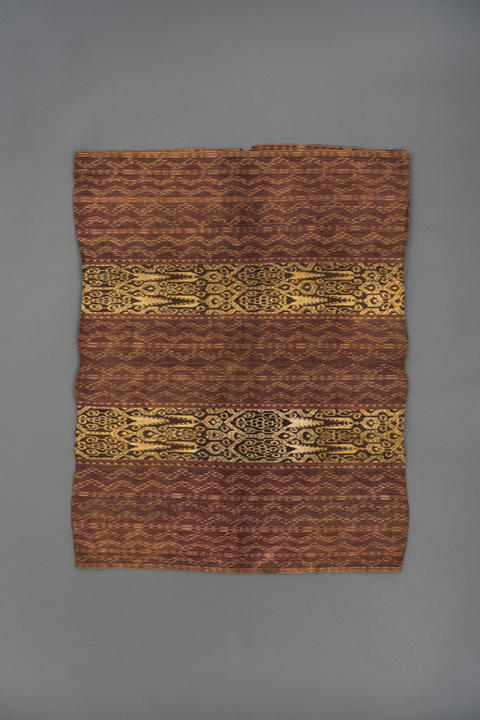
For hundreds of years, Philippine communities were weaving abaca (Musa textilis) fiber textiles for use as daily clothing as well as incorporating pieces into life rituals: the birth of a child, the healing of the sick, and coming of age, among others. The earliest textile discovered in the Philippines and the oldest warp ikat found in Southeast Asia was the Banton burial cloth from the Visayas region, a fourteenth-century blanket used to wrap the dead. By convention, it is crafted similarly to many Philippine textiles of today—with abaca, our favorite wild banana tree that, despite not yielding any fruit, produces a fiber so strong it is used as ropes for ships.It is dyed with the blackest brown from *kinarum* and hematite red from the *sikarig tree.*
Today, the Philippines’ 7,641 islands are dotted with weaving communities that traditionally use a backstrap or floor loom. They utilize pineapple, cotton, silk, and abaca fiber threads, practicing a variety of techniques such as supplementary weft, brocade weaves, tapestry weaves, and *ikat* or tie-dye.
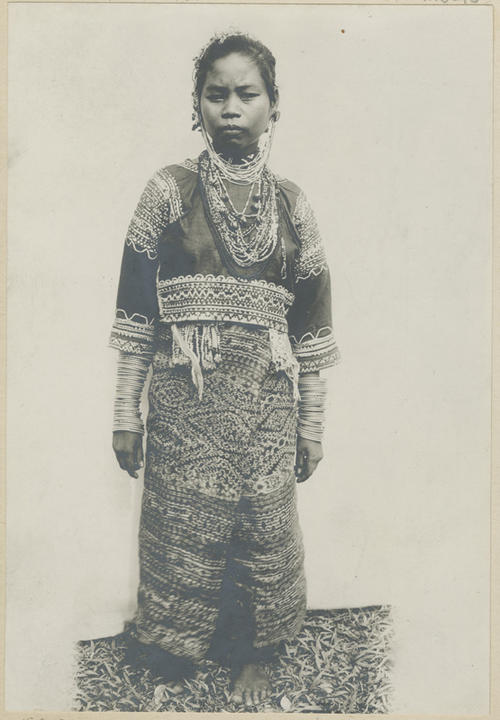
According to the family of the late Salinta Monon, a weaver, and National Living Treasure of the Bagobo Tagabawa Indigenous community, this piece is believed to be an inabal with ‘Ine’ or Mother design \[[1](/charissetugade#ftnref1)\]. It is a tubular wrap skirt for women, but can also be made into trousers and a jacket for men. Because ethnolinguistic groups around the Davao region (where the Bagobo are traditionally from) live so closely together, the inabal has vivid similarities to the pulaw of the Subanen and mabal tabih of the Blaan.
The art of weaving is highly technical, a rigorous discipline that entails significant time and effort, but the overall creation of inabal is a testament to the sophisticated skill and dedication of the wider community. For the weaving stage is merely a single step that comprises the entire process, the completion of which will require at least two to three people.
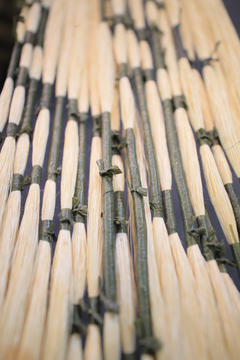
It begins with collecting a specific type of abaca in the bukid (from the mountain region), followed by hag-ot, a meticulous bark stripping through a metal comb, which is done until threads become as fine as maize hairs. It then goes through beating, or bayo, and cleaning, called onse. The fibers then go through suddong, wherein they are connected and knotted together to form a long, fine thread. This thread is then rolled into a ball, ready to be lined up on the frame for the subsequent design process.

Today’s inabal needs about six hundred to one thousand pieces of thread. The design process is reminiscent of tie-dying a shirt, except the threads are bound instead of binding fabric together. Laid onto a bamboo frame, the designer may begin to design by knotting and binding the pieces of thread together, called *binedbed*. In this process, art and mathematics interplay, as the accuracy of the knots' location horizontally and vertically determines the design. The designer therefore has to have a clear vision of the outcome, consistently maintained all throughout the process. In inabal, designs are repeated, meaning sizes must be measured, and knots must be spread out and counted. It is dyed several times depending on the color and number of intricate knots, then prepared for weaving. After this, the weaving process or *ginabal* begins. While the abaca takes several days to prepare, a weaver can weave at least half a meter to a meter per day. Once completed, it is washed in ash and ironed with a giant cowrie shell. One finished product of about four meters, such as this piece featured, can take a few weeks to process.
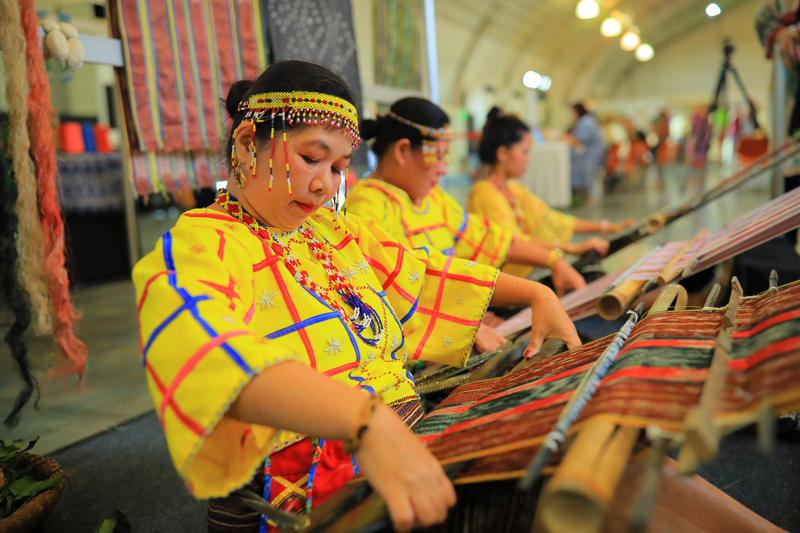
These conventions have since been disrupted, and while many of us might be predisposed to romanticize the sanctity of tradition, weavers are not only increasingly connected and exposed to modern-day conveniences, they also face the realities of making a living in a developing country.
*Ukay-ukay*, or used clothing, has dominated the countryside to the extent that a shirt can be sold for less than a dollar. The country still sees a brain drain, with one-fifth of the population (mainly from the countryside) leaving at any given time to live and work in the Middle East, the United States, Canada, and Europe. This is compounded by a renewed interest in Philippine textiles by Filipinos and Filipinos living abroad, which was not the case ten years ago. With the consumption of Indigenous clothing and textiles increasing in the cities, the fabric’s departure from the sphere of tradition and into the hands of fast-fashion designers and living rooms have also changed the trajectory of many weaving communities.
While many weavers, such as Salinta Monon’s only daughter Rose Monon, her granddaughter Rey Rose, and her daughter-in-law Gemma, are excited about the prospects that this renewed national interest has brought to the community, as coupled with the opportunities that have arisen through CulturAid and government initiatives, they also have to come to terms with the fact that much of the buying public has a keen interest in either of two things: *sinaunang* or antique designs, for home decorative display, or implementing traditional design on new materials that are light and airy for the tropical climate.
Because the Philippines was colonized for four hundred years, with the finest ethnographic material removed from its source continuously for the last one hundred and fifty years, Filipinos have virtually no access to early designs. Documentation has also remained almost exclusively among foreign and higher education institutions where weavers have almost no access. Research for and by the community is also still at a minimum. Thus, the most intricately designed textiles and important community heirlooms are not only lost to the communities that value them the most, but institutional memory is also slowly dying. Unfortunately, there then seems to be a demand among today’s generation of weavers to try to come to terms with remembering what they never learned. How, then, can weavers create their best work if they don’t have the memory of their greatest treasures? How can they innovate and rebel against their parents' traditional designs when they themselves still need to piece together their own story?
Salinta Monon is renowned as a master Bagobo weaver, but she died after just one year of teaching her children. Because her family was in need, most of her textiles were sold, save one single piece. For the communities I work with, I gather old photos of sinaunang textiles and share them, just so the young ones can learn something new and the elders can remember.
And how about the hungry Filipino consumers aching to wear their identity on their sleeves? It’s just too hot to wear abaca. Can we change out the loom type to ensure that production is quicker? Can we educate communities on new materials? Can convention be disrupted?
When I founded CulturAid more than ten years ago, it was based on the premise that we would work together with Philippine Indigenous communities to empower cultural bearers, document intangible and tangible cultural practices, educate the wider public, and find ways to sustain and reinvigorate practice, while ensuring that bearers thrive in their own space, in their own terms. Today, with Rose, Rey Rose, and Gemma, we try to get the best of both worlds: where traditions are kept through sinaunang designs but with room for conventional disruption.
## About the Contributor

Charisse Aquino-Tugade is the executive director of the National Book Development Board (NBDB), primary mover for CulturAid, founder of The Manila Collectible Co., and founding Director of Museo ng Muntinlupa. With interdisciplinary experience that spans the public and private sector, she creates an environment that empowers and amplifies voices, connecting communities and organizations that otherwise might not cross paths. As a cultural worker and founder of CulturAid, Charisse Aquino-Tugade works with Indigenous communities to reclaim their narrative through cultural mapping and developing heritage spaces, tours, and products. She established the CulturAid Iranun Weaving Center with Rocaya Sultan, a weaving outfit that weaves 100% cotton inaul. As the NBDB Executive Director, she has focused on expanding the domestic and international market through regional and global fairs, retail subsidies and the like. She also envisioned and spearheaded The Book Nook, storytelling and reading communities filled with Pinoy books for kids and kids-at-heart. To date, there are ninety Book Nooks from Ifugao to Tawi-Tawi.
Charisse has a B.A. in Anthropology and Marketing from San Francisco State University and is pursuing her graduate studies in Museum Studies at Harvard.
*Courtesy of Charisse Aquino-Tugade*
### Credits
Figure 1. Gift of the American Museum of Natural History in honor of Prof. Frederic Ward Putnam’s 50th anniversary at Harvard University, [06-20-70/66631](http://collections.peabody.harvard.edu/objects/details/88172).
Figure 2. Gift of William Cameron Forbes, [12-61-70/10861.1.12](http://collections.peabody.harvard.edu/objects/details/561140).
Figures 3, 4, and 5. Courtesy of Charisse Aquino-Tugade.
### Notes
\[[1](/charissetugade#ref1)\] This piece was created collaboratively by the author as well as contributing researcher and annotator Virgie Nicodemus and Rey Rose Monon Dillera, along with the knowledge and input of cultural bearers Rose Monon Dillera, Rey Rose Monon Dillera, and Gemma Monon.