# Marie Wasnock
##
expand\_more
## Portrait of a Filipina: Bright Stars and Guiding Lights of the William Cameron Forbes collections
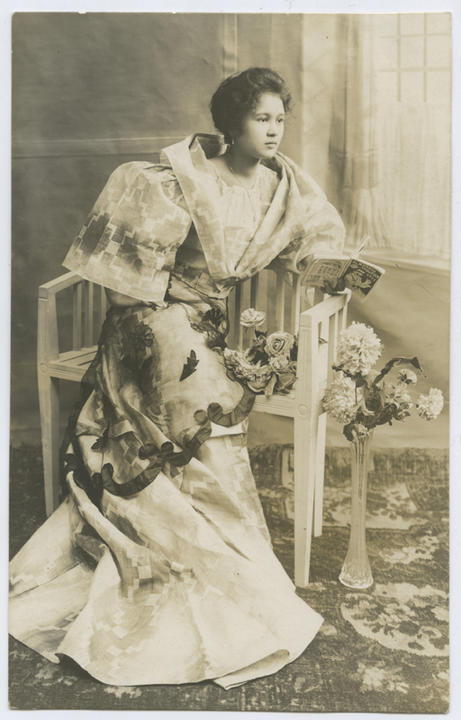
Tucked away in the archives of the Peabody Museum is William Cameron Forbes’ vast collection of more than five thousand photographs capturing the diversity of the Philippines in the late-nineteenth and early-twentieth centuries. This collection is as complex and distinctive as the country it represents—the Philippines: a biodiverse archipelago in the Pacific Ocean of more than seven thousand islands and over one hundred ethnolinguistic groups. A nation that was colonized by the western world (Spain, then the United States) for almost four hundred years, and only independent since 1946. While many Philippine images in the Peabody were photographed during the American colonial period (1898–1946) and were primarily used for ethnographic study, and scientific and social analysis, the collection also includes personal portraits and snapshots—mostly unidentified— revealing a nuanced view of life in early-twentieth-century Philippines—its communities, cultures, lands, industries, and the impact of colonial and imperialist influences.
I was first introduced to the Philippine photograph collection in 2021, in my first week as Associate Archivist at the PMAE. Fresh out of the fog of the COVID-19 pandemic, I never imagined I would be working at Harvard after a year of complete uncertainty. Within my first days on the job, a Filipino student contacted the archives to see the Philippines photographs, and it was a serendipitous first encounter at Harvard for a Filipino American archivist like me! I had worked with many archival collections before, but none so relevant to my own cultural heritage. I had also been curious about the Peabody’s collections from the Philippines, hoping to connect with my Filipino identity. However, I did not expect to find much in the Peabody, a museum known more for its North American collections, until this collection of photographs from the Philippines found me.
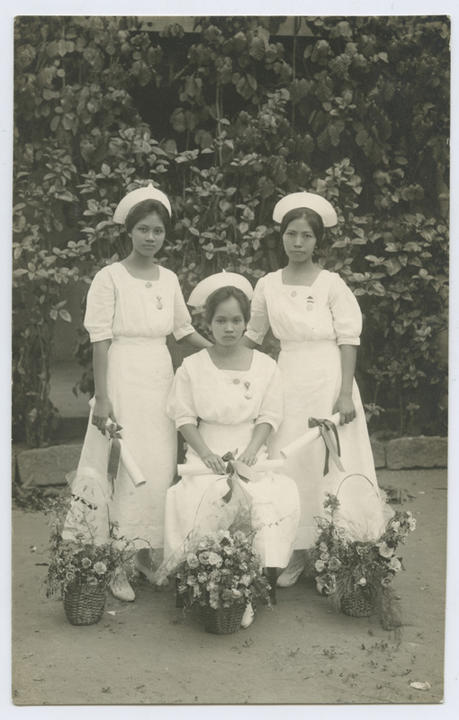
One photo album in the collection, simply labeled, “Album No. 3,” blared its siren call. A gilded art nouveau nymph embossed on the front cover forever blows her flute and heralds a series of graceful portraits inside— page after page of Filipina women elegantly dressed in traditional *baro’t saya* or blouse and skirt made of pineapple cloth, an Indigenous textile of the Philippines. Filipina nurses, musicians, scholars—their stories told by the props they hold...The backs of the photos imprinted with "POSTCARD," and some faded ink impressions of a greeting and a signature remain. But most are blank, like postcards never sent…And I still somehow connect with these women who lived more than a century before me, feeling a familiar kinship.
To understand this mysterious photo album of Filipinas, I had to learn more about William Cameron Forbes and his collection first. Born in Milton, Massachusetts in 1870, grandson of Transcendentalist philosopher Ralph Waldo Emerson, and 1892 graduate of Harvard College, Forbes was a New Englander through and through. By trade, he was an investment banker and later a diplomat appointed by US President William Taft to prominent government positions in the Philippines and Japan. From 1909 to 1913, he served as US Governor-General to the Philippines and kept detailed journals of his ten years living in the islands, in which he documented his experiences, personal reflections, and observations of the people and places he encountered in the Philippines. Forbes’ journals, along with other papers, photographs, and scrapbooks, are currently kept in Harvard’s Houghton Library and provide more context to understanding the Philippines photos in the Peabody and other repositories across Harvard University \[[1](/mariewasnock#ftnref1)\].
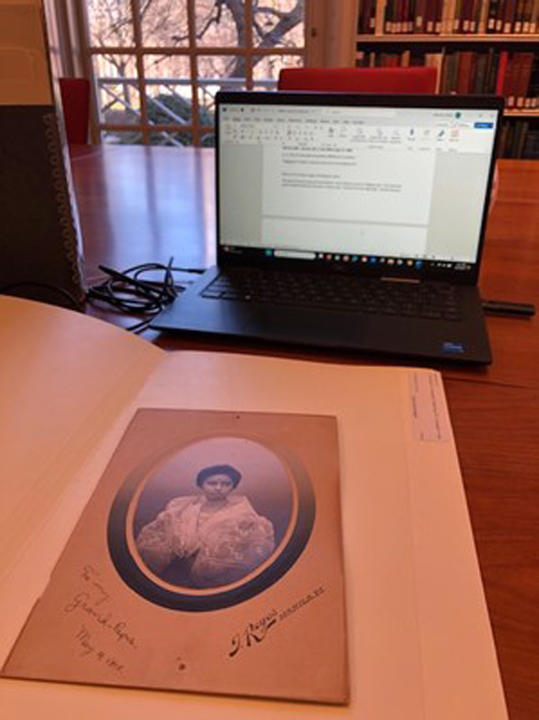
In ten volumes, Forbes details his journey from his first colonial appointment by US President William Taft to the Philippine Commission in 1904 to the year of Philippine independence in 1946. Houghton Library holds his original manuscripts, as well as typescripts \[[2](/mariewasnock#ftnref2)\] of his journals and an index \[[3](/mariewasnock#ftnref3)\], to help readers navigate the information contained in these volumes. Much of the information in Forbes’ journals formed the basis of his two-volume publication, *The Philippine Islands*. \[[4](/mariewasnock#ftnref4)\]
True to his diplomatic nature, Forbes tracked the progress of American presence in the Philippines, particularly their contributions to improving roads, bridges, and schools for the Filipinos. On May 21, 1910, his 40th birthday, he reflected on his life and asks, “Who but a mad dreamer could have planned such a career for me anyway—taken from counting house in Boston to go to the South Seas, and here, at forty, ruling over such a conglomeration of races, languages, customs, and divergencies as are to be found among the eight million who live in the Philippine Islands. Fifty years from now these will be one of the most remarkable and progressive peoples in the world, with great wealth and beautiful surroundings, living better and thriving more than almost any peoples anywhere…”\[[5](/mariewasnock#ftnref5)\] Forbes was optimistic that his leadership could enact positive change and progress for the Filipinos.
During his tours through the provinces and visits to American schools to witness this progress, he beams with delight like a proud father. Despite being barely 40 years old, the Filipina schoolgirls affectionately call him “Grandpa” and confide in him as a kind of paternal figure. A portrait from an Igorot student named Elizabeth Itang \[[6](/mariewasnock#ftnref6)\] is graciously signed, “To my Grand-Papa.”\[[7](/mariewasnock#ftnref7)\] Forbes recounts how the girls tell him stories about their lives and predicaments: “As we left the governor’s house at lunch, three women rushed up to me, and…began telling me a tale of woe in perfect English… It was a case where I could do nothing, but the fact that \[their\] complaint\[s\] were made in excellent English is a sign of the times. The ones who have learnt in the schools are beginning to be the people who have grown up and are taking part in the affairs of the country.”\[[8](/mariewasnock#ftnref8)\]
After one of his visits to the schools, Forbes remarks how he found “an array of granddaughters very cordial and kindly, with their “How do you do, Grandpa.’”\[[9](/mariewasnock#ftnref9)\]Among the class of promising Filipina students, Forbes gazes upon two “bright particular stars” who captured his attention: the Marquez sisters, Socorro and Paz.\[[10](/mariewasnock#ftnref10)\] He was particularly struck by the brilliance of Paz, “the most remarkable girl I met in the Philippines. She had wonderful poise, a great deal of looks…a very queenly poise of her head, and was made Empress of the Carnival.”\[[11](/mariewasnock#ftnref11)\]
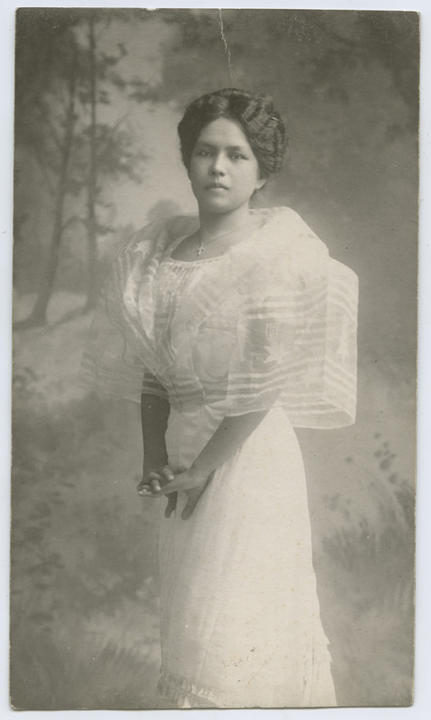
Forbes continues, “She has perfect command of English and even slang, and a roguish way of getting off rather cutting little witticisms under a demure exterior, and with hardly a twinkle to indicate that the thrust was intended, until she has 'got a rise,' or others of the party have taken the point and responded, when she joins with a strange slow smile. A very unusual girl.”\[[12](/mariewasnock#ftnref12)\]
He even recalls how Paz captures the attention of Philippine statesman (and future President) Manuel Quezon at a Palace dinner; he “kept writing little notes to her on his place card.” \[[13](/mariewasnock#ftnref13)\]
As a result of all this attention, Forbes playfully asks her, “'Well, Paz have you got a swelled head yet?' She assures him that, 'no she hadn’t and she wasn’t going to'…\[S\]he was walking along behind two women who were talking in Tagalog about her. One of them said, 'Well, what do you think of the Empress of the Carnival?' The other replied, 'Well, she isn’t very much to look at.' Paz remarked that she said to herself, 'Well, Pacita, that’s what you get.'”\[[14](/mariewasnock#ftnref14)\]
At the end of his footnote, Forbes finally reveals that Paz’s picture is “the first in the album of Filipina girls, Album No. 3". \[[15](/mariewasnock#ftnref15)\] It turns out that Paz Marquez, this bright star I’ve been following on my archival journey, also happens to be the star of Forbes’ mysterious Album No. 3!
After graduating from the University of the Philippines in Manila in 1912, Paz Marquez-Benitez became a teacher in her alma mater’s English department and developed a course in short story writing. She taught for 35 years until her retirement in 1951, inspiring and preceding future Filipino writers in English like Bienvenido Santos and Nick Joaquin. In March 1920, Forbes received a letter from Paz asking for money for a girls college which she was helping to found; she hoped to be an English professor in the college. \[[16](/mariewasnock#ftnref16)\] She was one of the founding members of the Philippine Women’s University. A former English major myself (to the chagrin of my Filipino parents who hoped I’d study something with more job prospects like nursing), I feel an even closer connection to Paz.
Paz eventually went on to write her first major short story in 1925 titled, *Dead Stars,* an allegory commenting on "American imperialism and the slow decay of Philippine heritage.” \[[17](/mariewasnock#ftnref17)\] It is considered the first modern Filipino short story in the English language. Google even created a “Google Doodle” in March 2023 as a tribute to Marquez-Benitez’s birthday and her contributions to Philippine literature. \[[18](/mariewasnock#ftnref18)\]
Meanwhile, there is a sky of other bright Filipina stars that remain unidentified in Forbes’ photo album. Could they possibly be the “Socorros, Rosarios, Rositas…and a world of others” he encountered and encouraged during his visits to the schools?\[[19](/mariewasnock#ftnref19)\] Only time and more research will tell…This is just the beginning of my journey. From my first introduction to the Forbes collection in my first week on the job, to this happenstance archival discovery…I like to think it was all written in the stars.
## About the Contributor
Marie Uytingco Wasnock was born and raised in Hawaiʻi to parents who emigrated from the Philippines. She visited the Philippines once as a child and fondly remembers picking *santol* from a huge tree in her aunt’s backyard, riding a carriage pulled by *carabao*, swimming in a hot spring, and attending class at a local school where she learned how to count from one to ten in Tagalog while the Filipino kids stared at her curiously. Marie would like to learn more Tagalog, but can proudly say that she still knows how to count from one to ten in the Filipino dialect and can still hum to warm memories of her mom singing “Pong Pong Kasili,” a Filipino nursery rhyme about a baby bird breaking out of her egg and spreading her wings.
Marie earned a B.A. in English and a MLISc in Library & Information Science at the University of Hawaiʻi at Mānoa, and moved to Massachusetts in 2006 to fulfill her dreams of working in archives, libraries, and museums.
Marie’s passion for literature, learning, and preserving history has inspired her nearly 20-year career in library and archival work. She has previously held positions at Emerson College, Lesley University, Lincoln Public Library, Cary Memorial Library, and the Concord Museum. Since 2021, she has been the Associate Archivist at the Peabody Museum of Archaeology & Ethnology at Harvard University. In her role, she supports the research goals of the Harvard community and of researchers worldwide.
[Read an interview with Marie](https://news.harvard.edu/gazette/story/2024/05/digging-into-the-philippines-collections-at-the-peabody-museum/) about her work as an archivist and her experience as a participant in *Balikbayan | Homecoming* in the Harvard Gazette.
*Courtesy of Marie Wasnock.*
### Credits
Figure 1: Gift of William Cameron Forbes, 1950, [50-81-00/1.13.22](http://collections.peabody.harvard.edu/objects/details/796383).
Figure 2: Gift of William Cameron Forbes, 1950, [50-81-00/1.13.23](http://collections.peabody.harvard.edu/objects/details/796385).
Figure 3: Photograph by and courtesy of Marie Wasnock.
Figure 4: Gift of William Cameron Forbes, 1950, [50-81-00/1.13.1](http://collections.peabody.harvard.edu/objects/details/796380).
### Notes
\[[1](/mariewasnock#ref1)\] See list of “William Cameron Forbes' Philippine collections at Harvard.”
\[[2](/mariewasnock#ref2)\] Forbes, William Cameron, 1870- Journals of W. Cameron Forbes \[first and second series\] : typescript carbon (signed: W. Cameron Forbes `92); \[various places\], 1904–1946. [https://hollisarchives.lib.harvard.edu/repositories/24/archival\_objects/591308](https://hollisarchives.lib.harvard.edu/repositories/24/archival_objects/591308)
\[[3](/mariewasnock#ref3)\] Index to journals of WCF. Typescript (photocopy). [https://hollisarchives.lib.harvard.edu/repositories/24/archival\_objects/591323](https://hollisarchives.lib.harvard.edu/repositories/24/archival_objects/591323)
\[[4](/mariewasnock#ref4)\] William Cameron Forbes. *The Philippine Islands* (Cambridge, The Riverside Press, 1928). [Volume 1](https://archive.org/details/philippineisland01forb/page/n7/mode/2up) and [Volume 2 ](https://archive.org/details/philippineisland02forb/page/n5/mode/2up) accessed on Internet Archive, March 11, 2024.
\[[5](/mariewasnock#ref5)\] Journals of W. Cameron Forbes, Vol. 4, May 10, 1910. MS Am 1364-1366, Houghton Library, Harvard University.
\[[6](/mariewasnock#ref6)\] J. Reyes (Manila, P.I.), photographer. Elizabeth Itang, 1910., 1910. [https://hollisarchives.lib.harvard.edu/repositories/24/archival\_objects/344832](https://hollisarchives.lib.harvard.edu/repositories/24/archival_objects/344832)
\[[7](/mariewasnock#ref7)\] W. Cameron Forbes images of the Philippines, 1907-1946. MS Am 2212, Houghton Library, Harvard University.
\[[8](/mariewasnock#ref8)\] Journals, Vol. 3, August 28, 1909, 261-262.
\[[9](/mariewasnock#ref9)\] Journals, Vol. 4, December 1910, 250.
\[[10](/mariewasnock#ref10)\] Journals, Vol. 3, September 25, 1909, 307.
\[[11](/mariewasnock#ref11)\] Journals, Vol. 3, Note 140, 443–444.
\[[12](/mariewasnock#ref12)\] Journals, Vol. 4, July 1910, 148.
\[[13](/mariewasnock#ref13)\] Journals, Vol. 3, Note 140, 443-444.
\[[14](/mariewasnock#ref14)\] Ibid.
\[[15](/mariewasnock#ref15)\] Ibid.
\[[16\] ](/mariewasnock#ref16)Ibid.
\[[17](/mariewasnock#ref17)\] *Paz Márquez-Benítez*, Wikipedia, [https://en.wikipedia.org/wiki/Paz\_M%C3%A1rquez-Ben%C3%ADtez](https://en.wikipedia.org/wiki/Paz_M%C3%A1rquez-Ben%C3%ADtez) , Accessed June 3, 2024.
\[[18\]](/mariewasnock#ref18) *Paz Marquez-Benitez’s 129th Birthday*, , Accessed June 3, 2024.
\[[19](/mariewasnock#ref19)\] Journals, Vol. 4, December 1910, p.251.
William Cameron Forbes' Philippine collections at Harvard:
*Houghton Library:*
MS Am 1364 – MS Am 1366 [W. Cameron Forbes papers](https://hollisarchives.lib.harvard.edu/repositories/24/resources/2341), 1900–1946.
MS Am 1192-1192.13 [W. Cameron Forbes additional papers](https://hollisarchives.lib.harvard.edu/repositories/24/resources/2342), 1904–1931.
MS Am 2212 [W. Cameron Forbes images of the Philippines](https://hollisarchives.lib.harvard.edu/repositories/24/resources/1405), 1907–1946.
MS Am 3279 [W. Cameron Forbes papers](https://hollisarchives.lib.harvard.edu/repositories/24/resources/9120). ca. 1871–1999.
*Fine Arts Library:*
[W. Cameron Forbes collection](https://id.lib.harvard.edu/alma/990118334890203941/catalog), 1910-1940 .