# Stephanie Syjuco
##
expand\_more
## Hands Floating, Faces Recognized: Escaping the Anthropological Gaze
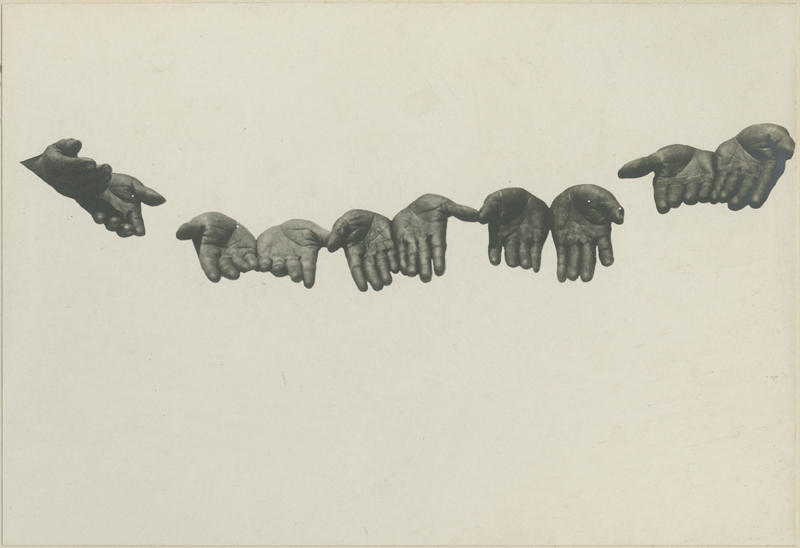
Five pairs of brown hands float amidst a cream background, palms up and tilted toward the camera. Gently cupped, they appear as if ready to receive a gift, or perhaps an offering. With their bodies visually cropped out, they are removed from personalization, and yet hang together in a community of others—hands posed in a gentle swaying line, almost like a garland or ribbon.
As an artist, I see this image as strangely beautiful and evocative, despite the fact that it sits within a folder of American ethnographic colonial-era images used to catalog and quantify Filipino subjects. These images were originally photographed and edited by Dean Conant Worcester, an American zoologist, public official, and self-styled authority on the Philippines who began his career there in the 1880s. Indeed, on closer inspection one can surmise that this image wasn’t meant to be poetic—the visual exclusion of the owners’ bodies was meant to isolate the hands into a photographic study of body parts, as evidenced by a similar but less-poetic image of five pairs of feet floating on a cream background. This image of floating hands, it turns out, is “complicated,” as it was taken in the Philippines right before a number of the subjects in the larger collection of photos appear to have been brought to the United States for display at the 1904 St. Louis World’s Fair.
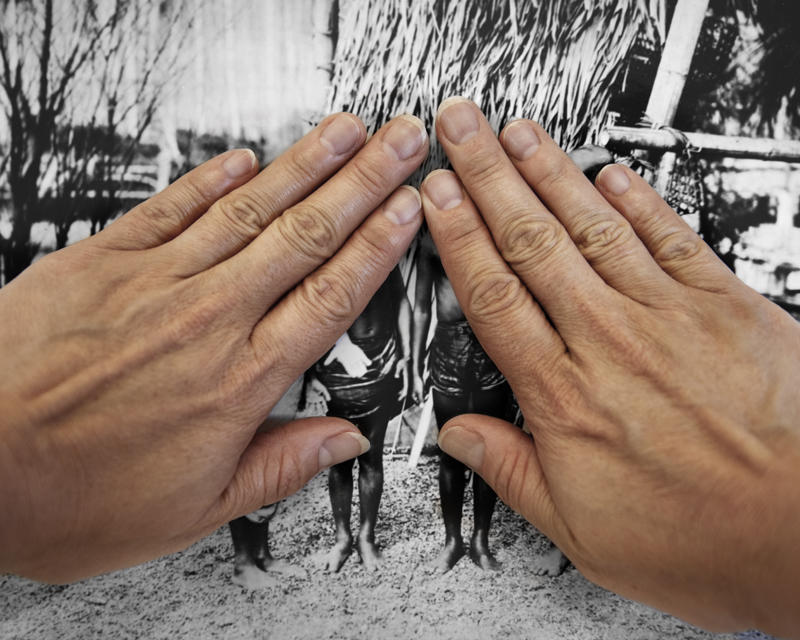
As an artist, I also make work with hands—*my* hands—and use them to crop, cover, and re-edit images within the colonial archive. In the series “Block Out the Sun,” 2019, I rephotograph images of Filipinos taken at the St. Louis World’s Fair, and use my hands in a similar fashion, but floating above a *visible* background. When I stumbled across the five pairs of floating hands in the Peabody collection I couldn’t help but pause and consider the time (100+ years) and distance between that photograph and my series, which attempts to gain back a type of visual agency.
> *What does it mean to not see yourself clearly?*
My recent work focuses on the problematic construction of American history and how photography informs deeply biased structures foregrounding whiteness as a normative subject. I use national archives and collections as visual source material for an investigation into the presence (or non-presence) of Filipinos and Filipinx Americans in these spaces. It’s a simple query: where are we, and what do we look like within these American archives? Where are we not? Where are we – accidentally? Where should we be?
I do not make work about Filipino identity, I make work about the white gaze, and those are two totally different things. Searching through an archive’s documents and photographs to “find” evidence of one’s cultural lineage and existence, it becomes clear that the American archive is not built for us, its colonial subjects. And when the archive is about us, it shows a frightening lack of clarity. If we were to take these archives as extensions of the American imagination, then that imagination is full of blind spots, holes, and fragments. We are seen, posed, and framed on the margins, or as props for a much extended narrative of Manifest Destiny. \[[1](/stephaniesyjuco#ftnref1)\]
The 1904 Louisiana Purchase Exhibition—also known as the St. Louis World’s Fair—imported over twelve hundres Filipinos to the middle of America to pose and perform in a complex of staged, faux-“native” villages. The photos generated from the “Philippine Reservation” were widely reproduced and readily consumed by an American public hungry to become acquainted with their recent colonial acquisition. As an artist researcher searching for historical images of Filipinos in America, these early colonial and World’s Fair photographs dominate the representation of Filipinos within the American archive, becoming a problematic early record that is difficult to escape.
And yet I do want these historical images to “escape” their conscripting limitations, or to at least tell a surprisingly different story of agency, if possible. One way to do this is to refute the primacy of the ethnographic image as totalizing narrative. By cross-referencing images of individuals rendered either anonymous or as static ethnographic sample across multiple institutional archives (the Peabody, the Smithsonian museums, the Library of Congress, the Missouri Historical Society, to name just a few), I can begin to recognize faces and piece together a humanity denied by the separate collections..
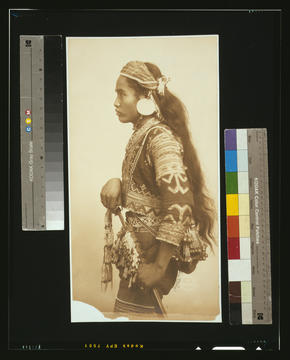
The Peabody collection contains a large selection of photos donated by W.C. Forbes, and featuring images of “Bagobos of Davao” taken in the Philippines. Although rendered anonymous in the captions, numerous individuals are recognizable as having then traveled to St. Louis, where they were the subject of countless staged photographs in the Philippine Reservation. The anonymous “Bagobo man” spotlighted above is later referred to in St. Louis as “Datu Bulon” (sometimes also spelled Datto) and his image was marketed in postcards to the American public as “Chief of the Bagobo” \[[2](/stephaniesyjuco#ftnref2)\] \[[3](/stephaniesyjuco#ftnref3)\].
Sort 
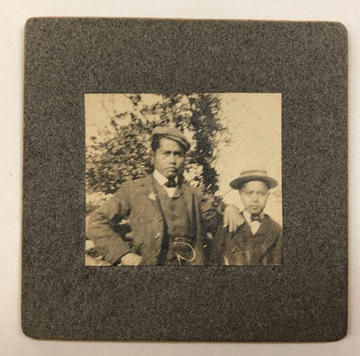
Meanwhile, in the Smithsonian National Anthropological Archives, images of the same Bagobo community at the St. Louis World’s Fair tell a different “complicated” story, specifically the photos taken by Elizabeth and Sara Metcalf \[[4](/stephaniesyjuco#ftnref4)\] two American sisters who befriended them and took numerous informal snapshots together across several visits.
Sort 
A similar treatment of a young Bagobo woman compares how she is shown in an ethnographic context in the Peabody collection, versus subsequent, more humanized images taken by the Metcalf sisters.
Sort 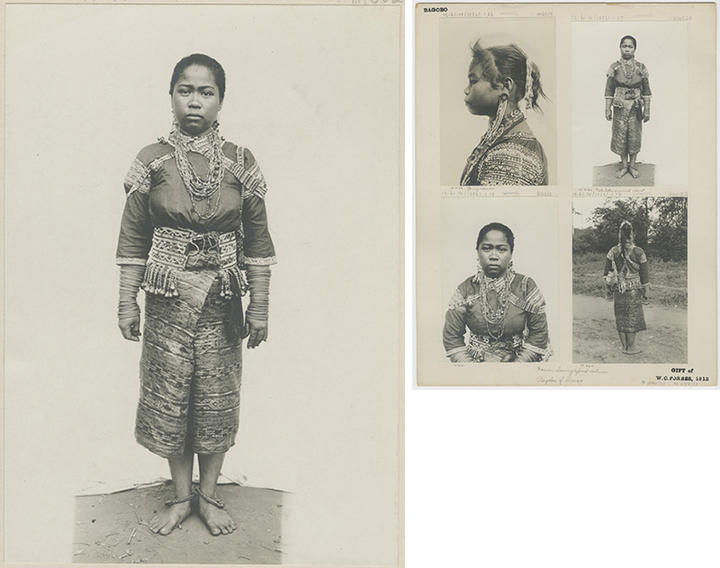
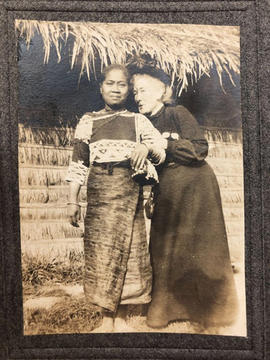
It is my hope that the *recognition* across multiple collections begins to create a depth of individuality in these “anonymous” subjects, potentially granting them an ability to refuse the codification of the anthropological gaze \[[5](/stephaniesyjuco#ftnref5)\]. These images could allow them to speak differently, and actually, finally, be *seen.* The floating hands I shared at the beginning of this essay, separated from their identities against a blank backdrop, do not have to operate as metaphoric fragments, but can be allowed to migrate back to full personhood.
## About the Contributor
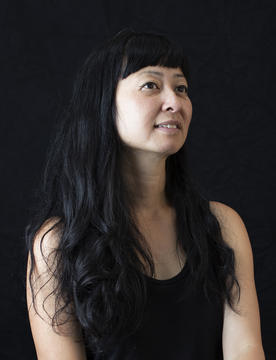
Stephanie Syjuco works in photography, sculpture, and installation, moving from handmade and craft-inspired mediums to digital editing and archive excavations. Recently, she has focused on how photography and image-based processes are implicated in the construction of racialized, exclusionary narratives of history and citizenship. Born in the Philippines, she is the recipient of a Guggenheim Fellowship and has exhibited widely, including at the Museum of Modern Art, the Whitney Museum, and the San Francisco Museum of Modern Art, among others. She is an associate professor at the University of California, Berkeley, and resides in Oakland, California.
*Photograph by Kija Lucas. Courtesy of Stephanie Syjuco.*
### Credits
Figure 1. Gift of William Cameron Forbes, [12-61-70/10861.1.901](http://collections.peabody.harvard.edu/objects/details/557728).
Figure 2. Courtesy of Stephanie Syjuco.
Figure 3. Gift of William Cameron Forbes, [12-61-70/10861.1.47](http://collections.peabody.harvard.edu/objects/details/561175).
Figure 4. Gerhard Sisters, Copyright Claimant, Gerhard Sisters, photographer. Bagobo Chief. Saint Louis Missouri, ca. 1904. Photograph. [LOT 8211, no. 16](https://www.loc.gov/item/2004666301/).
Figures 5, 6 and 8. National Anthropological Archives, Smithsonian Institution Photo Lot 107. Rephotographed by Stephanie Syjuco, 2019.
Figure 7. Gift of William Cameron Forbes, [12-61-70/10861.1.17](http://collections.peabody.harvard.edu/objects/details/561145)
### Notes
\[[1](/stephaniesyjuco#ref1)\] The above two paragraphs are excerpted from my recent monograph *Stephanie Syjuco: The Unruly Archive* published by Radius Books, April 2024.
\[[2](/stephaniesyjuco#ref2)\] A potentially dubious title, given that it may have been a sensational marketing tactic.
\[[3](/stephaniesyjuco#ref3)\] The Miriam and Ira D. Wallach Division of Art, Prints and Photographs: Picture Collection, The New York Public Library. "Datto Bulon, chief of the Bagobo, dressed in warrior attire. Philippine Reservation, 1904 Louisiana Purchase Exposition." New York Public Library Digital Collections. Accessed May 23, 2024.
\[[4](/stephaniesyjuco#ref4)\] Wikipedia entry for Elizabeth and Sara Metcalf [https://en.wikipedia.org/wiki/Elizabeth\_H.\_Metcalf](https://en.wikipedia.org/wiki/Elizabeth_H._Metcalf)
\[[5](/stephaniesyjuco#ref5)\] Other important contributions that similarly are working towards this end include Janna Añonuevo Langholz’s project,[ “1,200 Lives and Deaths at the World’s Fair”](https://www.jannalangholz.com/1200-lives-and-deaths) (2021–ongoing) which attempts to match the names and faces of the many Filipinos rendered anonymous or only partially recognized. And a named index of peoples displayed at the 1904 World’s Fair can be found in: Parenzo, Nancy J., and Don D. Fowler. "Anthropology Goes to the Fair: The 1904 Louisiana Purchase Exposition." University of Nebraska Press, 2007, 415-416.