


Asösö: Resting collectively and Rising collectively
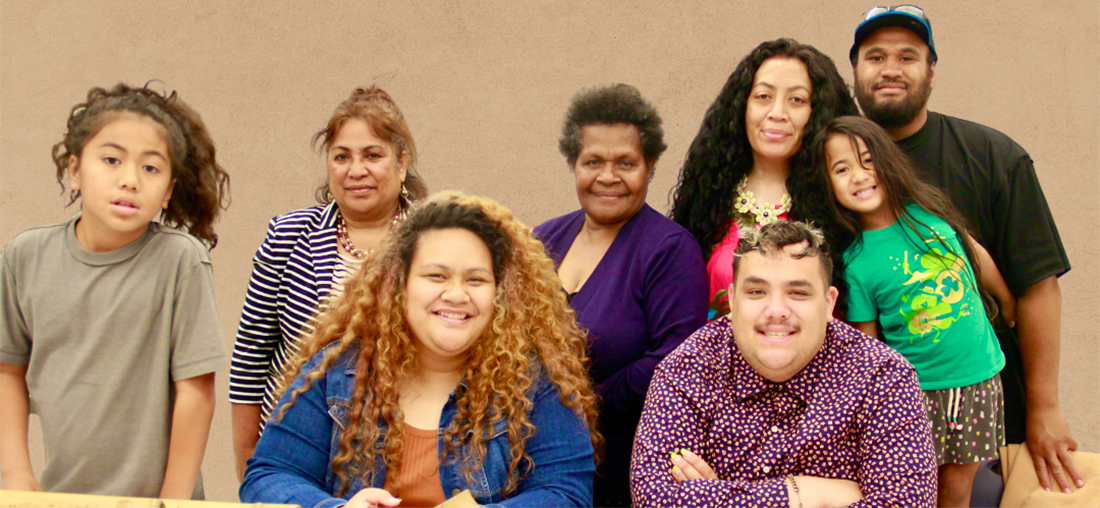
'Amelia Afā Niumeitolu Tavai collaborated with a diverse group of Pacific Island cultural leaders and artists in Utah, including Susan Alik, Poli O'toko, and Tagielu Tavai to explore the collective and mobile nature of rest shared across Oceanic cultures. Reflecting upon several headrests from the Oceanic collections at the Peabody Museum as well as historic photographs, the group aimed to underscore the healing importance of resting and sharing culture as a group, as understood through the Chuukese expression asösö meaning "our rest."

The Chuukese term asösö means literally to rest or take vacation, but according to HOCEF project members Poli O'toko (Chuuk) and 'Amelia Leafaitulagi Niumeitolu Taai (Tonga) who goes by Afā `Aikona, it can also be interpreted as “our rest,” implying a collective nature. This HOCEF project explores the concept of rest through the lenses of collectivity, connectivity, and mobility to highlight how Oceanic peoples prioritized rest and have a great need to restore that model in the daily lives of those living in the United States today.
As project leader Afā `Aikona states:
“When I say collective rest, my language encompasses that of the fauna, flora, the village. Labor is stopped. The insects, mother nature rests with the members of the community and the community rests with the relatives of insects, the ocean, the moon, the plants, the trees, the birds, the boars, and chickens. This provides for one of the most important Indigenous values: harmony. When everyone rests, individuals are able to re-imagine and rise collectively.”
This artistic exploration of rest utilizes the large number of wooden headrests or "pillows" in the museum collections from across Oceania as a source of inspiration. These tangible expressions of rest are a means to celebrate the diverse yet interconnected concepts of rest throughout the region and connect to their ancestral makers.

Asösö: Resting collectively and Rising collectively is ambitious in its scope and exceptional in its inclusion of Pacific Islanders from across the region, including many now living in the United States. The individuals involved hail from the Marshall Islands, Hawai'i, Chuuk, Samoa, Papua New Guinea and Tonga. Several youth and school groups in Utah were involved as well, encouraging Pacific Islander students to think about what rest looks like to them, resulting in some creative drawings like the one shown here by a Tongan youth.


In June 2022, several members of the HOCEF group—'Amelia Leafaitulagi Niumeitolu Taai, Susan Alik, Ti Tavai, Theclah Krasombi Taylor, Pele Mana, Tangata ‘o Lakepa, Tausoa Mulitalo, and Jakey Siolo—came to Harvard to spend several days in person with the collections at the Peabody Museum to inform their project and learn more about the Oceanic collections more broadly. During the visit, over thirty headrests were examined closely, held, and discussed.


The project has resulted in a unique combination of photographic portraits (see Hear from the Fellows in the next section), youth art, and video interviews. Watch some video highlights of the project and museum visit, created by the team and ‘aikona. The project culminated in a large-scale public multimedia installation presented on August 12, 2022 at the 25th Annual Friendly Islands Tonga Festival hosted by the National Tongan American Society. Set up all weekend at Jordan Park in Salt Lake City, an outdoor pavilion was transformed into an Oceanic home with mats lining the floors, historic prints from the islands and family portraits hanging from the walls, and a treasured ngatu (tapa cloth) from Tongan ancestors.

The Asösö: Resting collectively and Rising collectively project was a collaborative one, and included a large number of people and supporting institutions, including 'Amelia Leafaitulagi Niumeitolu Taai, Susan Alik, Ti Tavai, Theclah Krasombi Taylor, Pele Mana, Tangata ‘o Lakepa , Paul O’toko, Tausoa Mulitalo, Jakey Siolo, Sinia Maile, Siolo Toala, Vina Tura, Lauren Ulugia, Ovava Afuha’amango, Sisi’uno Helu, Alamoti Lavaki, Dr. Angela Robinson, and Tangata ‘o Lakepa Niumeitolu.
They were all brought together by 'Amelia Leafaitulagi Niumeitolu Taai, who goes by Afā `Aikona in her artistic endeavors. Watch her explain the meaning of `aikona (3:38). She is the daughter of Tongan parents Tangata 'o Lakepa (Kolomotu'a, Niu'afo'ou, Vava'u) and Litia Makakaufaki (Ha'ano, Ha'apai, 'Eua and Fatai, Tonga), but is truly a woman of Oceania with ancestors from Samoa and Fiji, and ties to Papua New Guinea where her grandparents lived during their Methodist mission. She has lived and worked in Tonga for years as well as American Samoa, Samoa, Fiji, Hawai'i, and California.
Learn More About Headrests in the Collections
All across Oceania, and elsewhere in the world, headrests (or pillows) are fashioned from wood in a large variety of shapes and sizes to support the neck and to protect men's elaborate hairstyles from flattening during sleep in places like Fiji. In some societies, a person’s spirit or sacred lifeforce (mana) resides in the head and should be protected from the ground. The diversity across the region is incredible: some were painstakingly carved with smooth elegant curves or individual bowed legs; some feature inlaid whale bone beads or intricate designs resembling animals; and others made clever use of bamboo segments. Headrests could be small and portable with braided cordage for carrying, or they could be over ten feet long, capable of providing space for a whole family.
Headrests were practical but they also hold greater significance for many Pacific Islanders as a metaphor for shared cultural learning. It is customary for mothers and grandmothers to tell stories of cultural significance to their children in the evenings as they lay upon her outstretched arms resembling a long headrest. In Tonga, the arm and this practice is sometimes referred to as kaliloa, the word for a communal wooden headrest used by several people at once.
A Variety of Forms
Within each island group, there may be different types and styles of headrests which are sometimes given different names. This kali from Fiji has a simpler form than the following two.

A Former Weapon Turned Headrest
The form of this headrest from Fiji—with its straight rod and bowed legs—is often referred to as a kalimasi yavalolo. But it has a unique detail that gives it the name kalimasi gadi: it was constructed from a repurposed weapon called a gadi. The gadi, like this one, is a straight pole club with an intricately carved handle. In this kali, the carved designs can still be made out, suggesting its former use.


The Donut Kali
This fine kali from Fiji is carved from a single piece of wood and features a common form seen in many Fijian headrests – a central round form, sometimes referred to by museum researchers as “donut” shaped. Its inlaid decoration suggests it may have belonged to someone of high status.

Look Closely
Historically, inlaid decoration was often made of cut whalebone pieces, but in this case, several hundred small white glass beads (probably imported) adorn the headrest.


Theme and Variation: A Fijian Bamboo Headrest
Broadly speaking, headrests in both Fiji and Tonga are called kali. And in Samoa, they are commonly known as ali, demonstrating the close historical and cultural relationship between all three island groups. All three are known to use carved wood as well as bamboo in the various headrest forms, many remarkably similar. Compare this bamboo headrest from Fiji (kali bitu) to the next one, from Samoa. Can you spot any differences? Hint: look at the “legs.”

Theme and Variation: A Samoan Bamboo Headrest
This bamboo ali from Samoa is over 3.5 feet long and was likely used by more than one person, laying next to one another. Another one in the collection measures over 6 feet long!

Personalizing a Headrest
Oftentimes, people would incise their names or initials onto these bamboo headrests. In the case of these longer ones, multiple names or initials can be found, perhaps indicating each person’s ‘spot’ on the ‘pillow’ shared by family members.


Form and function
In Tonga, headrests had different names based on their shape and function. While there may have been many others, today most people are familiar with two main types: the kali hahapo, with one wide leg at each end (like the one shown here) and the kali toloni, with a pair of bowed legs at each end. A kali loa (literally, long kali) are large enough to be used by more than one person and can be of either hahapo or toloni shape.

A Unique Form from Tonga
This unique and precisely carved headrest from Tonga balances perfectly on its two narrow ends. It is one of the oldest in the collections, thought to have been collected by La Billardier, a French natural historian accompanying Bruni d’Entrecasteaux's 1791–1794 expedition to the Pacific in search of the missing French explorer la Perouse, considered one of the greatest maritime mysteries of the eighteenth century. There are no known others like it in museum collections, although a variation with two legs at one end and only one leg at the other was collected on Captain Cook's third voyage by William Griffin (Royal Museums Greenwich AAA2851).

A Pandanus Pillow
In Hawai`i, headrests were often made from the pandanus tree, not carved from wood like elsewhere in Polynesia, but woven from its leaves into a rectangular log shape, filled with rolled up leaves for comfort. Similar ones were made in Japan and Southeast Asia from rattan.

Sleeping Amongst Animals
Further west in the Pacific Ocean, headrests from Papua New Guinea (PNG) and Indonesia are both distinct and varied. In the lower Sepik River region of PNG, headrests often feature the heads of important animals which have ancestral and sacred significance.
Oceanic or African?
Carved headrests are not only found across Oceania but across the globe and continue to be used today, including ceramic ones from China, alabaster pedestals from Egypt, and a great diversity of carved wooden headrests from the African continent. Similarities in design mean that sometimes they get misidentified in museum collections. For example, in the 1940s when this piece came to the museum, staff labeled this headrest as coming from Fiji, based on the central circular shape found in other kali like 98-8-70/51736 and 00-8-70/55296. Despite this similarity, it is more likely African.
