


Breaking the Silence - Nineteenth-Century Indian Delegations
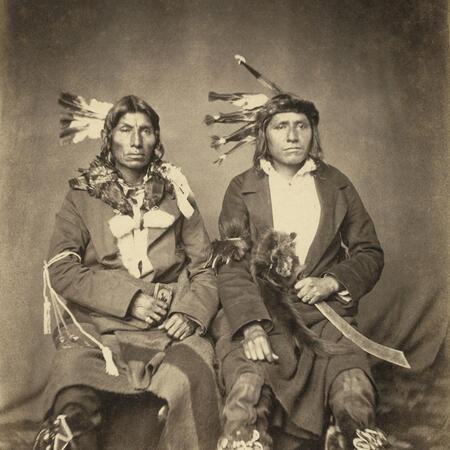
Little Crow (Che-tan-wa-ku-te-a-ma-na or Hawk that Hunts Walking), 1810-1863, and His Own Thunder (Wa-kin-yan-to-wa), both of Mdewakanton Dakota Nation. Portrait by Julian Vannerson and Samuel A. Cohner, 1858. 2004.1.125.22
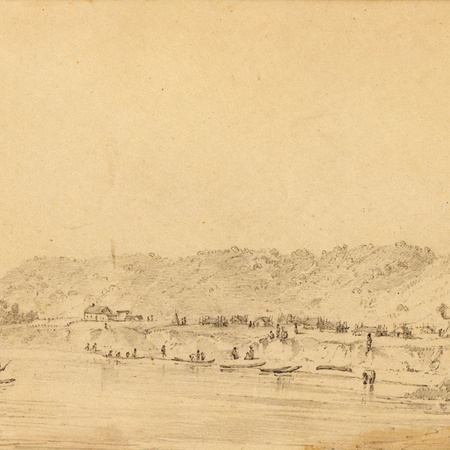
Little Crow's village, located 853 miles above St. Louis, ca. 1848, pencil and paper drawing by Seth Eastman. PM 41-72-10/95
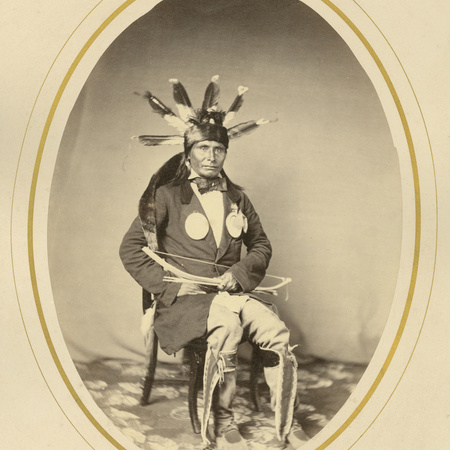
Red Ensign, Wabasha or Red Leaf, Santee Dakota Chief (Mdewakanton), 1817-1876. Portrait by A. Zeno Shindler, 1867. PM 2004.1.144.34
John Other Day, Am-pa-tu-to-ka-cha, Wahpeton Dakota Warrior, 1810-1871. Portrait by Julian Vannerson and Samuel A. Cohner, 1858. PM 2004.1.144.51
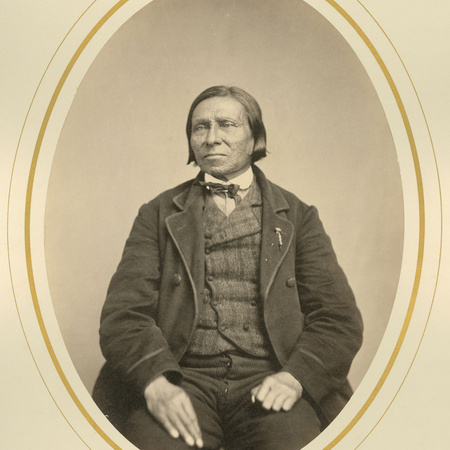
Red Ensign, Wabasha or Red Leaf, Santee Dakota Chief (Mdewakanton), 1817-1876. Portrait by A. Zeno Shindler, 1867. PM 2004.1.144.34
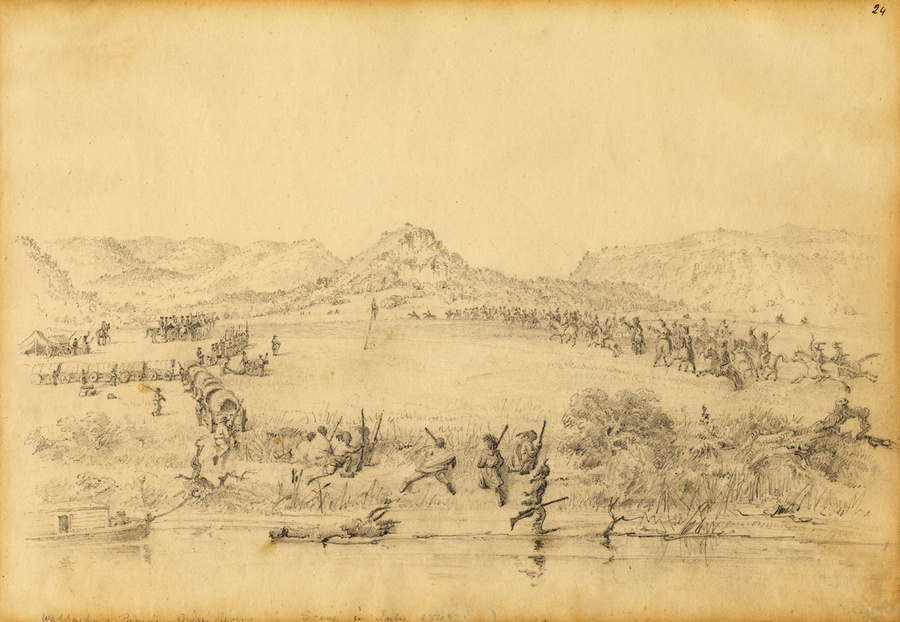
Red Ensign's community located along the Mississippi River, July 1848. Pencil and paper drawing by Seth Eastman. PM 41-72-10/82
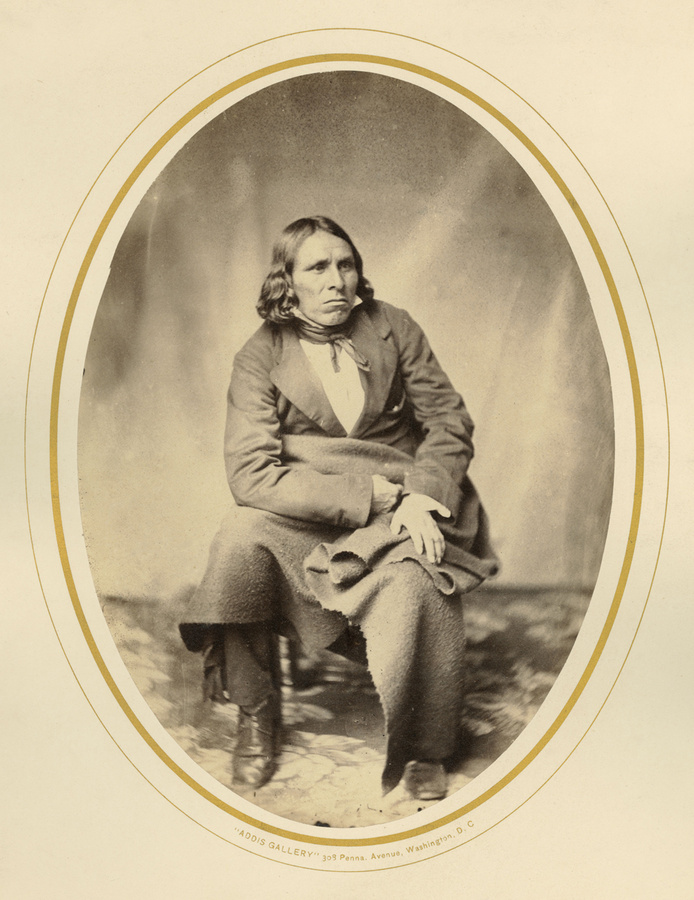
Iron Shooter, Paul Mazakutemani, or Little Paul. Wahpeton Dakota Elective Chief, 1806-1885. Portrait by Julian Vannerson and Samuel A. Cohner, 1858. PM 2004.1.144.48
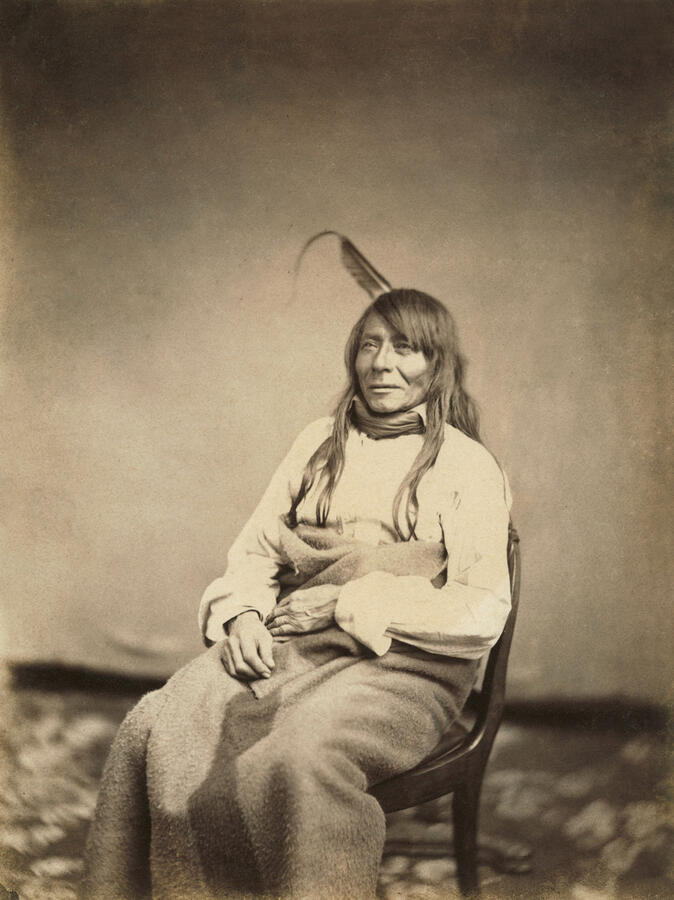
Struck by the Ree, Palaneapape, Yankton Dakota Chief, 1804-1888. Portrait by Vannerson and Cohner, 1858. 2004.1.125.14
Read more about the delegates
Little Crow and His Own Thunder
"Where shall we go? We know the country ... and we know not of any of fit for us to live upon"—Asakiwaki (Sac) and Mesquakie (Fox) chiefs to George Manypenny, Commissioner of the Office of Indian Affairs, October 7, 1853 (Herring 1990:88).
During the mid-nineteenth century, as non-Indians (Americans, Europeans, and African-Americans) crossed the upper western plains of the United States, Dakota (Sioux), Pawnee, Ponca, Anishinaabe (Chipewa), Mesquakie (Fox), and Asakiwaki (Sac) Indian communities struggled to protect their land and cultures. The U.S. Government negotiated treaties with them, promising clothing, food, and protection on reservations in exchange for ceded territory and guaranteed peace. Nevertheless, many Indians faced disease, starvation, and demoralization due to overcrowding, meager rations, and the embezzlement of tribal money. Tensions grew, precipitating armed conflicts, most notably the 1857 Spirit Lake Uprising and the Dakota Uprising of 1862, when over 800 settlers were killed and 38 Dakotas executed for their participation.
Between 1850 and 1867, delegations of influential Indian community leaders traveled to Washington, D.C., to describe reservation conditions and discuss treaties. Although many were traditional leaders, chosen by their people, the U.S. government appointed others because of their compliancy. While native leaders saw these visits as nation-to-nation conversations, U.S. officials used these meetings to demonstrate America's wealth and military power.
During these trips, the delegates were photographed in professional studios. These portraits were then available to the general public in bound volumes or as single prints, with little written documentation.
One hundred and forty-seven years later, using words from the Indian leaders themselves, this exhibit contextualizes the portraits, showing how Indian delegates created a place for themselves and their communities during the United States' nation-building process. Here, the portraits are no longer silent. Listen to what they say about the leaders' lives, families, and place in American history.
Read more about the delegates
Little Crow and His Own Thunder
The first son of Chief Wakenyantanka and his wife Minneakadawin, Little Crow (on the left in the photo) traveled to Washington, D.C., in 1858 to discuss broken treaties. During the Dakota Uprising, Little Crow led several attacks. His Own Thunder, on the other hand, was on the opposite side, helping to alert non-Indian settlers. Little Crow was killed by a settler the next year while picking raspberries in Minnesota with his son, Wowinape (Comes in Sight). The Minnesota Historical Society displayed Little Crow's skeleton and scalp until the 1970s, when his body was returned to the Dakota for proper burial.
"We have no food, but here are these stores, filled with food. We ask that you [the agent] make some arrangement by which we can get food from the stores, or else we may take our own way to keep ourselves from starving."—Little Crow to Thomas Galbraith, Indian Agent, just prior to the Dakota Rising (Barton 1919: 48-49)
John Other Day
Born in Swan Lake, Minnesota, John Other Day was the son of Zitkaduta (Red Bird). He was viewed as a "friendly" to non-Indians following his rescue of settlers during the 1857 Spirit Lake and the 1862 Dakota uprisings. Other Day represented the Wahpetons and the Sissetons in treaty negotiations. While in Washington, he married a local waitress. In this portrait, Other Day is wearing peace medals and European dress, emphasizing that he was considered a "friendly." After his death, he was buried with military honors at Big Coulie in Montana.
Red Ensign
Son of Old Wabasha, Red Ensign became chief in 1837. He reluctantly signed treaties in 1851 and 1858, protesting that they were against his people's best interests. Although opposed to war, he joined Little Crow in the Dakota Uprising. Afterward, he lived at the Santee Agency (reservation) in Nebraska until his death.
Iron Shooter
Cousin of Little Crow and son of Old Eve, Iron Shooter was one of the first pupils at Thomas Williamson's Christian mission school at Lac qui Parle in Minnesota. In the 1850s, he was president of the Hazelwood Republic, a group of Christian Dakota farmers. In the 1857 Spirit Lake Uprising, Iron Shooter and John Other Day rescued a non-Indian woman. A member of the 1858 Wahpeton Dakota delegation, he advocated peace among the Mdewakantons, Sissetons, and the Wahpetons. During the Dakota Uprising, Iron Shooter helped lead settlers to safety. Later, he wrote about the Dakota Wars. He died on the Sisseton Reservation in South Dakota.
"Warriors and young men!—I am Indian, and you are Indians, and there should be no secrets between us. Why, then, did you not tell us that you were going to kill the whites? . . . The end of the world is near at hand for the nation of the Dakotas. Every Indian knows that we cannot live without the aid of the white man. Why, then, have you acted like children?"—From the Reminiscences of Paul Mazakutemani (1880 [3]:82)
Struck By the Ree
Legend has it that Struck by the Ree was born while the Corps of Discovery camped in the Yankton homeland along the Missouri River and Meriwether Lewis wrapped the newborn in an American flag, declaring him "an American." Instrumental in Yankton Dakota and U.S. government relations, Struck by the Ree traveled to Washington in 1858 and 1867. During the Dakota Uprising, he was considered a "friendly" because he placed his warriors between militants and settlers. When he died, Struck by the Ree was buried with a peace medal from a Washington visit, along with a medal his father had received from President Thomas Jefferson.
"My friend, I have a good leg, . . . and I want to go to Washington to see my Great Father. . . . My belly is full of what I want to say to him."—Struck by the Ree, on behalf of the Yankton, to A. W. Hubbard, member of the Congressional Indian Commission, Crow Creek Agency, August 1865 (Report of the Joint Special Committee 1867:366)