


Azadeh Akhlaghi Exhibition "From Iran: A Visual Testimony" to Open at Harvard’s Peabody Museum May 15
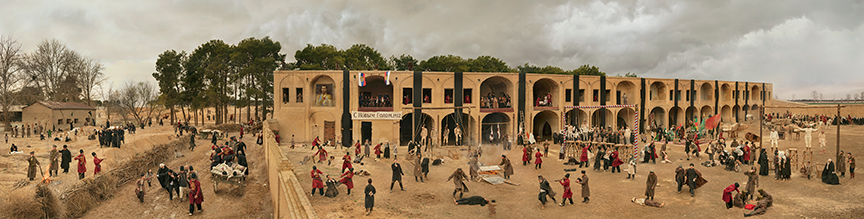
Tabriz | December 1911–October 1917 After Russia forced the dissolution of Iran’s parliament in December 1911, Russian troops occupied Tabriz and carried out brutal reprisals. Photographs of the massacre, later published by E. G. Browne, shocked the world. Among the victims were two boys executed on Ashura, whose mother’s grief inspired The Mother of Tabriz. The mother appears on the right. She is accompanied by a young girl and consoled by a woman (depicted by Akhlaghi herself).
“By reconstructing events that were never photographed, I seek to question the authority of images and the ways collective memory is shaped through absence as much as through evidence.” — Azadeh Akhlaghi
The Peabody Museum of Archaeology & Ethnology at Harvard University presents From Iran: A Visual Testimony, a new exhibition by Iranian photographer and filmmaker Azadeh Akhlaghi. The exhibition has been in development since she was named the museum’s 2019 Robert Gardner Fellow in Photography. From Iran: A Visual Testimony will be on view Friday, May 15, 2026–Sunday, March 21, 2027, at the Peabody Museum of Archaeology & Ethnology (11 Divinity Avenue, Cambridge, MA).
Created over the course of fourteen years, Akhlaghi’s project stages and photographs pivotal moments from Iran’s tumultuous twentieth-century history. Drawing on meticulous archival research and her background in cinema, she casts professional and nonprofessional actors and photographs each scene from multiple angles to reimagine historical events as complex tableaux, set in real locations in Iran.
In sixteen images—three presented as large-scale prints—Akhlaghi depicts eleven pivotal incidents highlighting the cycle of successful and failed efforts by Iranians to reclaim control of their country between 1908—when the Shah quashed the first National Assembly—and 1979, when the monarchy was overthrown and Islamic rule began.
The exhibition’s video loop depicts incidents that illuminate recurring cycles of successful and failed efforts by Iranians to reclaim control of their country.
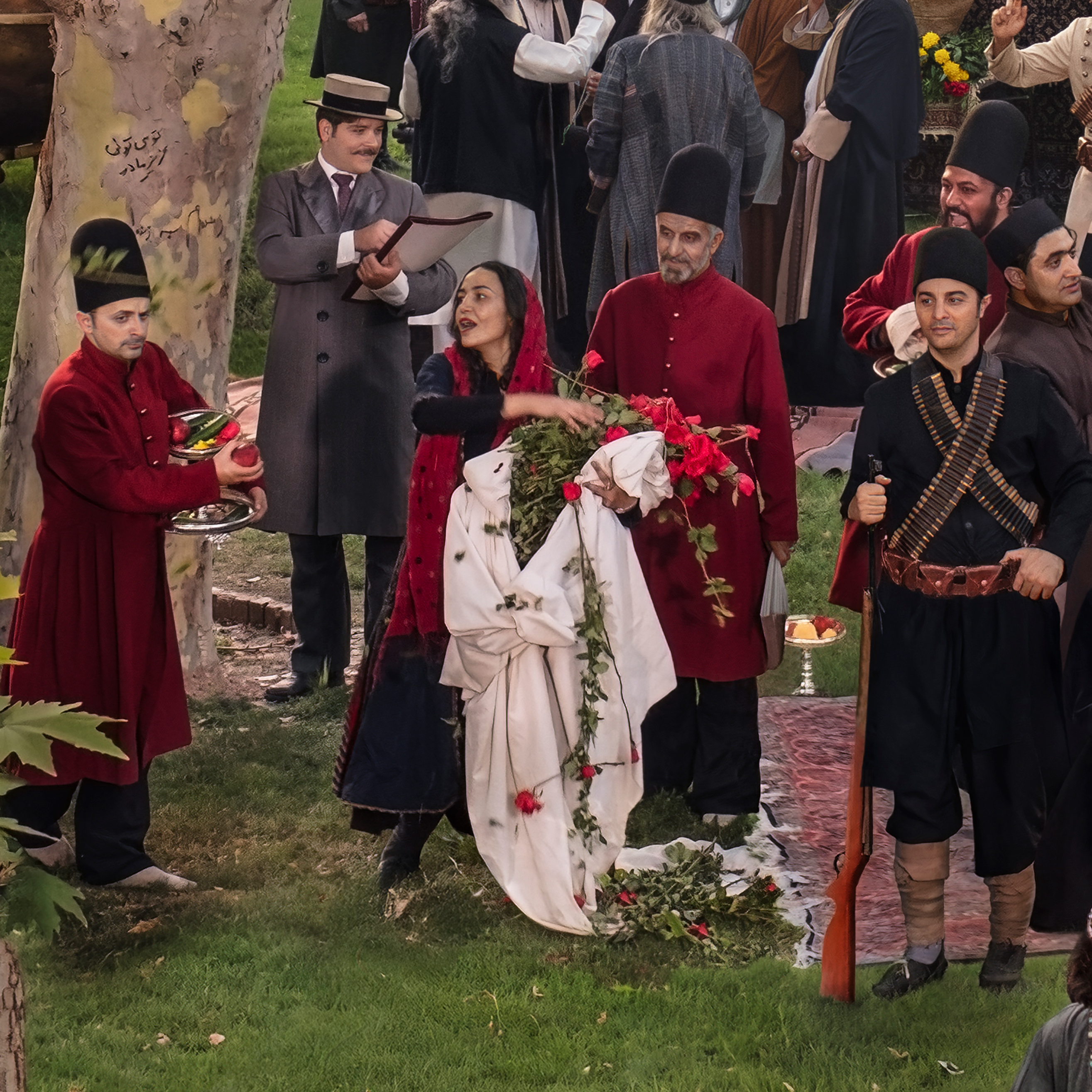
Zahir al-Dowleh’s Residence, Tehran | August 20, 1909
An interactive display invites visitors to explore archival materials behind Akhlaghi’s interpretations and offers a behind-the-scenes look at her process. In each scene, Akhlaghi places herself within the image as both participant and witness, offering visual testimony to her country’s turbulent history.
About Azadeh Akhlaghi
Azadeh Akhlaghi (b. 1978, Shiraz) grew up in Mashhad, Iran, and studied computer science at the Royal Melbourne Institute of Technology in Australia. She later returned to Iran, worked as assistant director to filmmaker Abbas Kiarostami (2005–2008), and made short films before turning to staged photography in 2009. She won the 2009 UN-Habitat Youth Photography Competition and was a finalist for the 2016 Sovereign Asian Art Prize. Her work By an Eyewitness has been exhibited internationally, including in the United States, London, Paris, Shanghai, Seoul, and Tehran.
About the Peabody Museum of Archaeology & Ethnology
The Peabody Museum of Archaeology & Ethnology is one of the four Harvard Museums of Science & Culture (HMSC). For directions, exhibition schedules, lectures, and information on parking, visit the websites peabody.harvard.edu and hmsc.harvard.edu.
About the Robert Gardner Fellowship in Photography
The Peabody Museum’s Robert Gardner Fellowship in Photography supports an established photographic practitioner in producing—and publishing through the Peabody Museum—a major project “on the human condition anywhere in the world.” The fellowship provides a $50,000 stipend and culminates in the publication of a book.
About the Harvard Museums of Science & Culture
The Harvard Museums of Science & Culture connect collections and research at Harvard with global audiences, fostering community and deepening appreciation for science, the natural world, human cultures, and our shared experiences.
The Harvard Museums of Science & Culture (HMSC), established in 2012, provides core operational support and public-facing activities at six museums within the Faculty of Arts and Sciences (FAS) at Harvard University for the benefit of the campus community, the greater Cambridge and Boston area, and visitors from around the world. HMSC partners with the Collection of Historical Scientific Instruments (CHSI), the Harvard Museum of the Ancient Near East (HMANE), the Peabody Museum of Archaeology and Ethnology, and the Harvard Museum of Natural History (HMNH), the public face of the three research institutions: the Harvard University Herbaria (HUH), the Mineralogical and Geological Museum (MGMH), and the Museum of Comparative Zoology (MCZ).
View the calendar of events, sign up for our HMSC Connects! newsletter, and learn more about becoming a member.
See hours and admission rates on each of the HMSC museums open to the public:
- Collection of Historical Scientific Instruments
- Harvard Museum of Natural History
- Harvard Museum of the Ancient Near East
- Peabody Museum of Archaeology & Ethnology
Press Contact
Faith Sutter
Media & Communications Specialist
Harvard Museums of Science & Culture
617-495-3397