


(re)Constructing an Object's Story
Provenance at the Peabody

While the term provenance in museums often refers to a record of an object’s ownership history, provenance should tell a broader story. It is a biography, the story of an object’s life. Where did it originate? How did it arrive at a museum? Who cared for it along the way?
Our first step in provenance research is to study the original cataloging documents to determine what information was given to the museum when the item was accessioned. For example, the Accession Card shown here contains some notes about this vessel’s history, including the maker’s culture and who gave it to the Peabody. However, there is still a lot of information missing—too often further records do not exist, memories have faded, or those who may have held answers have passed away. So what happens when the donor “does not remember from whom” he purchased a Peruvian vessel?
We are left to piece together provenance through archival and object research, seeking threads to reconnect this vessel to its history.

Deciphering Provenance

We know where this vessel was likely made and who donated it to the museum, but how do we learn the rest of its biography? We begin by studying the object itself—the physical marks and labels on the bottom of this vessel can tell us about its provenance.
(A) Red bordered rectangular label
Our colleagues at the Museum of Fine Arts, Boston were able to use the information on this sticker to determine that the vessel was on loan to the MFA from Mrs. Silvio De Gozzaldi from 1914 until 1925. Further research revealed her full name, Mary Isabella de Gozzaldi, but we do not know how or when she collected the vessel.
We also don’t know where the vessel was from 1925 until 1938. A likely scenario is it was returned to De Gozzaldi at the end of the MFA loan in 1925 and after her death in 1935, her family sold or gave it away and it made its way, either directly or indirectly, to Pleasants in 1938.
(B) Cuzco, handwritten in ink
The Peruvian town of Cuzco (Cusco) may have been where the vessel was sold. Or possibly the seller wanted to associate the vessel with the town’s name because it is recognizable and near the well-known archaeological site of Machu Picchu. The writing below it, which appears to read “Hu Pet”, has not been deciphered—it may refer to an archaeological site or town.
The MFA’s rectangular label sits atop this label, telling us that the Cuzco note was already on the bottom of the vessel before it was loaned to the MFA in 1914.
(C) 8.00
Likely reflects a sale price, whether it was from a transaction that resulted in the vessel leaving Peru or a later sale is unknown.
(D) White label "3"
This small rectangular typewritten sticker is also affixed to the bottom of the vessel on top of the “Cuzco” label. Its source or meaning remains a mystery, possibly a catalog number from another collection or an exhibition.
(E) 39-4-30/1812
The Peabody’s catalog number is written in red ink. The prefix “39-4” tells us the vessel was accessioned by the Museum in 1939, and it belonged to the fourth accession of collections that year. “30” is the Peabody’s geographic code indicating the piece is from South America. The catalog number of “1812” completes the unique identifying number. Museum catalog numbers like this one are an important tool for tracking collections and all their associated information.
Frederick Pleasants: Donor and “Monuments Man”


Frederick Rhodes Pleasants, a Harvard graduate student (class of 1938) and Peabody Museum employee, donated this and one other Peruvian vessel to the museum in 1939. At the time, he stated he did not remember whom he purchased them from. Nearly 100 years later, we still do not know. Archival research shows us he was living in New York while working at the Buffalo Museum of Science in 1938, the year he bought the Peruvian vessels. His correspondence also mentions traveling to Washington, Santa Fe, New Orleans, and Chicago during that year, adding to the list of potential purchase locations.
Pleasants would eventually come to understand the importance of provenance and record keeping all too well. In 1946, he was the Director of the Munich Central Collecting Point (CCP) in Germany, making him a member of the Allied armies’ Monuments, Fine Arts, and Archives Section Unit, commonly called “the Monuments Men”. The CCP’s main objective was returning art stolen by the Nazi regime during World War II. The Nazis often kept detailed records of provenance in their looting—those records aided in the return of many of the stolen works.
After the war, Pleasants returned to the Peabody before moving on to become a curator at the Brooklyn Museum and eventually settling in Arizona. The vessels he donated to the Peabody were likely some of the first items he acquired for what would become his extensive collections of mostly Central and South American artworks. Over the years, he purchased artwork from prominent New York dealers such as Joseph Brummer, Pierre Matisse, and Charles Ratton, among others, but we have been unable to find any record of the Peruvian vessels that he donated to the Peabody Museum coming through one of those galleries.

Mary Isabella De Gozzaldi

Can knowing more about the MFA’s lender, Mrs. Silvio De Gozzaldi, help us with provenance research? Born in 1852 as Mary Isabella Batchelder James, her maiden name tells us she belonged to two prominent New England families. As a historian, she served as the founder and Vice-President of the Cambridge Historical Society, established in 1905. De Gozzaldi also had an interest in ceramics, giving numerous talks on the topic around the Boston area in the early 1900s. It is possible this vessel is one of the rare antique pieces that came to her through a family member, as described in this 1912 Cambridge Tribune advertisement.
After De Gozzaldi’s death in 1935, probate records show her estate and belongings being distributed to her family in 1936. Her daughter, Amy Gozzaldi Hall, donated a ceramic piece to Harvard’s Fogg Museum (now the Harvard Art Museums) in 1936. The Peabody also received collections from Amy on behalf of the De Gozzaldi estate in 1936. This Peruvian vessel may have been gifted or sold by the family in 1936 as well, perhaps to whomever Pleasants acquired it from.
Lost provenience
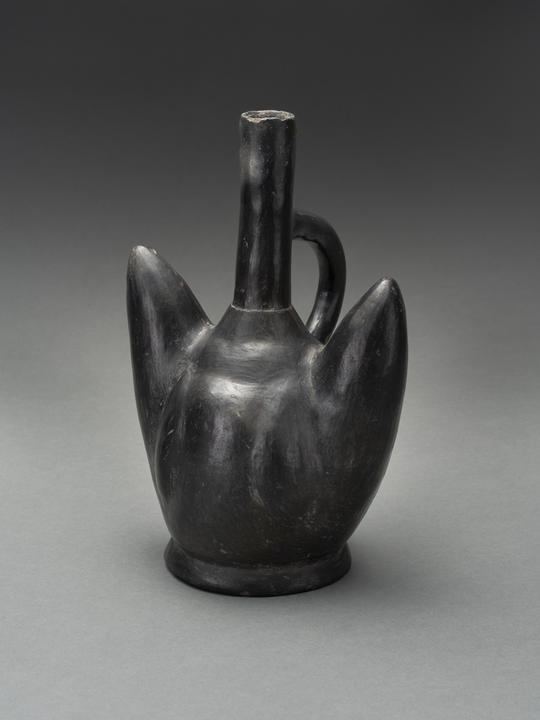
The form and style of this black ceramic vessel indicate that it was created by an Indigenous artist living in Chimor (the Chimú Empire) approximately 1000-1500 years ago, in what is now Peru.
Unfortunately, because we don’t know the exact site it came from, the artist can only be presumed by comparing the vessel with others known to be made by the Chimú culture. Without documentation of the exact archaeological setting an artifact comes from, also known as its provenience, part of this vessel’s history will never be known. Professional archaeological excavations are careful to record and study all aspects of a site, helping us better understand people and their lives. Indigenous descendant communities provide additional knowledge, including oral histories, on past makers and cultural practices to give us a fuller picture.
An Ongoing Journey
An object’s provenance is rarely complete. As new information is discovered about this vessel, museum records and this page will be updated. While past collecting practices and a lack of written records mean that we may never learn individual artists’ names, researching collection histories can help us reconnect items with their Indigenous and descendant communities. Documenting how collections came into the Peabody also allows us to teach the broader history of museum collecting and understand our institution’s role in establishing anthropological collecting practices.
Acknowledgments
Researching provenance is most often a collaborative process, one source rarely holds all of the information. Staff at multiple institutions were vital to this work, searching their records and collections, helping me to follow different leads in what can be described as an ancient detective story. This vessel encountered many people on its journey to the Peabody—it makes sense it would take collaboration to recreate that history. A gracious thank you to all of you who helped along the way.
Diana Zlatanovski, Associate Curator
Bibliography
Frederick Pleasants Application for Federal Employment, February 15, 1946. Record Group 239: Records of the American Commission for the Protection and Salvage of Artistic and Historic Monuments in War Areas; Series: Correspondence Relating to Personnel; File Unit: Personnel—Available, Peck Through Von Moltke, 1945-1946
Frederick Pleasants correspondence. Paul J. Sachs Papers (HC 3), folder 1499. Harvard Art Museums Archives, Harvard University, Cambridge, MA.
Mary Isabella Gozzaldi Papers, 1844-1952. n.d. History Cambridge. https://historycambridge.org/finding-aids/mary-isabella-gozzaldi-papers-1844-1952/.
Mary Isabella Gozzaldi probate records #205024. Massachusetts Supreme Judicial Court (SJC) archives.
Monuments Men and Women Foundation “Frederick R. Pleasants | (1906–1976) | Monuments Men and Women.” https://www.monumentsmenandwomenfnd.org/monuments-men-and-women/frederick-pleasants.
Peabody Museum of Archaeology and Ethnology catalog and accession cards.
Pillsbury, Joanne, Luis Jaime Castillo, Christopher B. Donnan, et al. 2017. Golden Kingdoms: Luxury Arts in the Ancient Americas. J. Paul Getty Museum : Getty Research Institute.