


From Sacred Cenote to Museum Storage
From Sacred Cenote to Museum Storage:
The (Unfinished) Story of a Contested Collection
by Rebecca J. Mendoza
This is a story about thousands of materials that were excavated from the ancient sacred Maya ceremonial site of Chichén Itzá in the Yucatán Peninsula of Mexico and are currently in the collections of the Harvard Peabody Museum of Ethnology and Archaeology in Cambridge, Massachusetts.
Follow along to learn about the history of this contentious museum collection, to consider the meaning of these materials in Maya cosmovisons, and to imagine possibilities for the future.
Part I: Where it begins
In the Yucatán Peninsula of Mexico there are thousands of deep sinkholes we call cenotes, a word adapted from the Yucatec Mayan term tz’onot. This landscape of limestone allows rainfall to enter and expand crevices, creating caves, springs, and streams under the surface. A cenote forms when these caves collapse, opening to the surface and sky.
For thousands of years people have made their homes near cenotes. They are places where the soil is moist for agriculture and the limestone filters the rainfall to provide potable water. But cenotes are also important religious sites, a sacred place for ceremony and ritual. Cenotes are access points to the watery underworld, associated with deities like Chahk (also spelled Chaac or Chac).
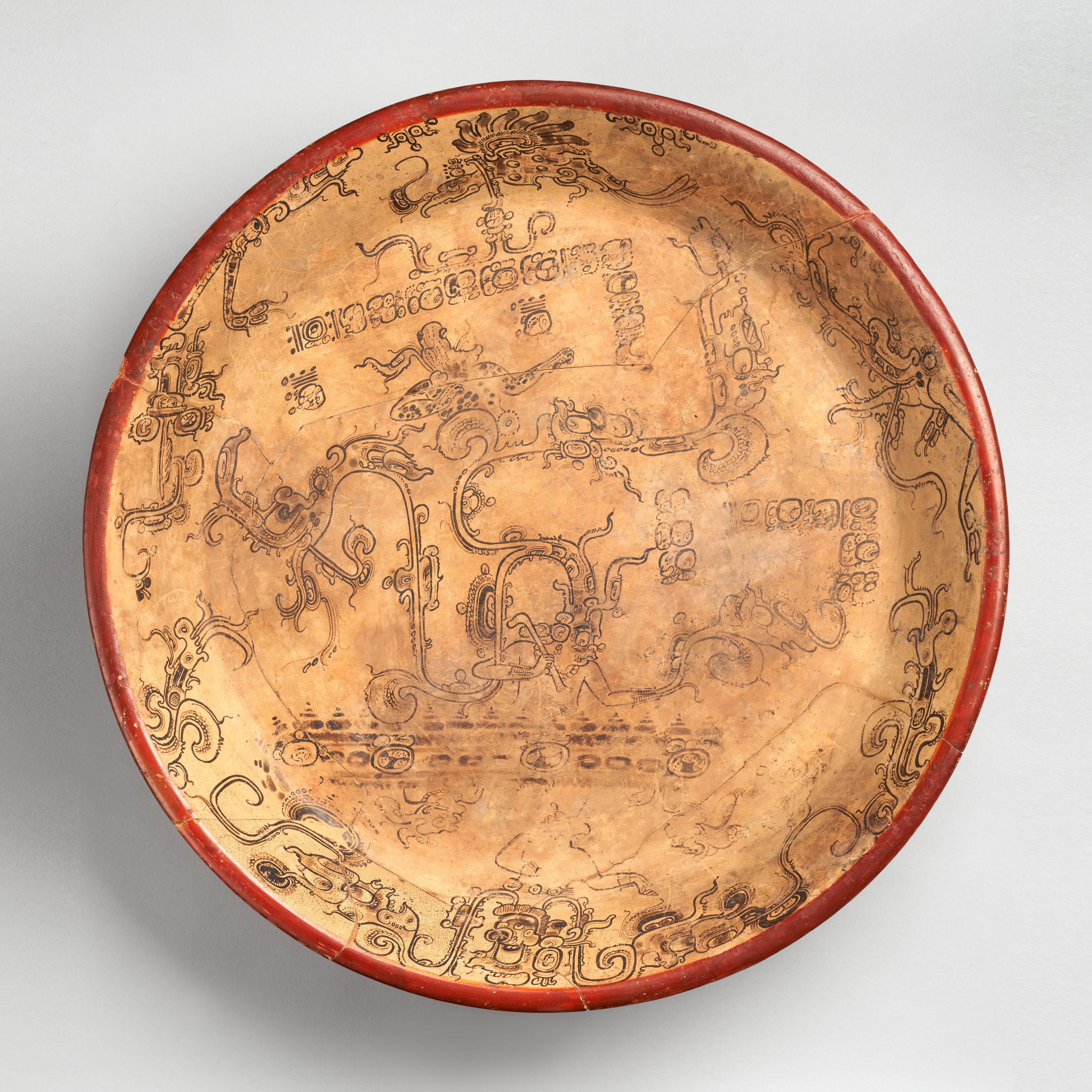
Chahk is the powerful god of rain, storms, and lightning. He is often depicted with a lightning axe in his hand, positioned in the sky, dwelling in a cenote, or emerging from the underworld (see the vessel below, currently at The Met Museum, in which Chahk is waist deep in the dark waters of a cenote).

The cenote at Chichén Itzá is one of the largest in the region and is known as the Cenote Sagrado or Sacred Cenote.
While the region has been home to Indigenous peoples for millennia, Chichén Itzá was a large and powerful Maya center between 850-1150 CE. The earliest archaeological materials from the cenote date back to 750 CE, and while the majority of offerings were deposited before Spanish colonization, a rayon doll from the 20th century reveals that the site remained an ongoing place of pilgrimage.
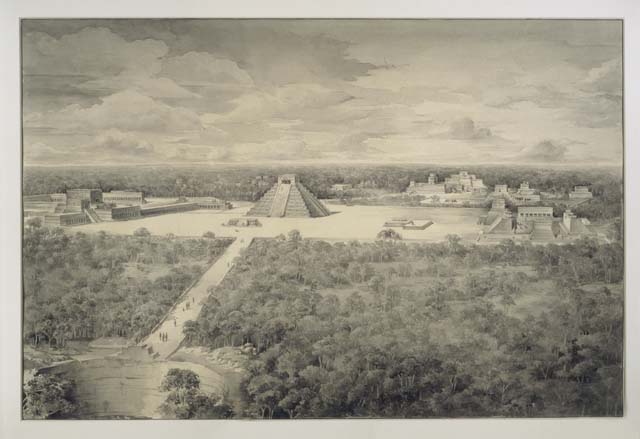
Like many cities in Mesoamerica, Chichén Itzá’s ceremonial center is carefully aligned according to the sky, the land, and the underworld. The Temple of Kukulkán, for example, is offset 21° from the cardinal points, so that its central axis aligns with the solar zenith passage sunset and the nadir passage sunrise.
The central plaza of Chichén Itzá also includes the Temple of Warriors, the Great Ball Court, and a raised white limestone road (called a sacbe) connects the plaza to the Cenote Sagrado.
Learn more about Maya ceremonial centers
The Maya observed and recorded the yearly cycles of the Sun and the seasons in the architecture of of their ancestral cities.
The Maya deposited offerings into the cenote including precious stones, wooden figurines, ceramics, incense, gold, shells, as well as human and animal sacrifices. There are various ways of interpreting these offerings but there is no doubt that these were materials of great value for humans, gods, and the cosmos.
Here are a few examples of the ceremonies essential to balance the cosmos and nurture deities:
Copal (copalli in Nahuatl or pom in many Mayan languages), an aromatic tree resin and incense, was a major part of ceremonies in Mesoamerica.
In this image we see examples of molded figurines: human faces, animals, and sacred foods like maize were often depicted. We can also see an example of resin with balls of rubber inside. Rubber was another sacred Maya element (used for ball games) that would also help to burn the resin and produce a sweet, piney scent and billows of thick smoke. In Mesoamerican cosmovision resin is tree blood, a sacrifice much like human bloodletting or heart offerings. In one account from the Popol Wuj a maiden tricked the Lords of the Underworld by offering pom instead of her heart.
This example of carved jade depicts another sacred plant important to the gods and Maya elites—the cacao tree. In precolonial times, cacao was made into a ceremonial beverage for marriage or birth, taken as tribute by rulers, and exchanged like currency. Additionally, green stones were associated with fertility, water, and preciousness, like the color of the quetzal bird’s feathers.


Gold was of value to the Maya, but not as currency in the way of the Spanish. Gold, like feathers, was appreciated for its color and shine. Like resin, it could be molded, and like wood, it could be carved. The materiality of gold—its characteristics—is what was important, not an abstracted, monetary value.
The Cenote collection includes thin gold disks that were crumpled up, as though balled up in a fist (but they were later unwrapped at the Peabody Museum, as seen in the image). Intricate images on disks like this one might include ritual scenes, warfare, features of rain gods, and other designs, perhaps pertaining to specific calendar days. Additionally, many of the copper bells found in the Cenote were fractured, crushed, and blackened. These materials can be seen as sacrificial offerings alongside humans and animals, ritually “killed” as they were crumpled or burned. This was an important part of feeding the gods and releasing power into this sacred site.
While maize and cacao decompose more quickly, leaving less physical evidence, precious stones, metals, and copal resin were preserved by the cenote for centuries. These offerings are also depicted in murals and ceramic vessels, as well as written about in glyphs and remembered through ongoing ritual practices throughout the region. Combining various pieces of evidence allows scholars and descendants to better understand the precolonial world and particular places like Chichén Itzá.
These thousands of materials given as offerings were not treated as inert objects. Mayan languages, like many other Indigenous languages, reveal degrees of animacy, or life force, which moves through various types of beings. Humans may be unique in some ways, but they are not the only ones who are treated as alive, animate, or agential. In these contexts humans relate to the more-than-human world with deep respect and reciprocity.
Therefore, we must think about these Cenote offerings as more than objects—they are ensouled, they can live and die and were meant to decay and release life force into the visible and invisible ecosystem of the Cenote.
Animacy & Indigenous Languages
While this may feel foreign to many, this ethic of respectful relationships and reciprocity with the more-than-human world exists across the globe in both ancient and contemporary cultures. What if we saw our industrialized treatment of objects as a truly strange or foreign exception? Across Mesoamerica (and other Indigenous traditions) these life forces have various names which are often translated as soul, heat, energy, or electricity. They animate mountains, plants, ceramic vessels, animals, stones, and even the numbers on the calendar.
Language Term
Nahuatl teotl
Mixtec yīī, ini
Zapotec pèe
Chatino cryasa
Classic Mayan k'uh
Chol Mayan & Tzeltalan chu’lel
Examples of Indigenous Mesoamerican terminology for life force or energy

Continuity and Change in Maya Ceremony
To appreciate this collection of offerings and its current exile from its place of origin requires that we take inventory of centuries colonial violence and the erasure of Indigenous knowledge and lifeways. Because of these acts, there is so much we do not know. Spanish missionaries and conquistadors burned books and sacred items, punished people for practicing ancestral traditions, and enforced conversion to Catholicism and their definition of “civilization.”
Yet, millions of Maya people maintain their traditions and languages today, both in their traditional territories as well as in the diaspora. Maya peoples, places, and practices have survived through resistance and creativity and continue to produce works of literature, art, and music, to calculate celestial events, and to carry forward their cosmovision. Examples include the lives and work of ritual specialists such as day-keepers (Ajq’ijab in the Highlands of Guatemala), language teachers, and healers (curanderas, parteras, etc.). Many of these communities are also Catholic, and individuals may belong to a variety of other religious or cultural organizations; for centuries they have found creative ways to honor various religious inheritances. Authenticity and purity tests are often rooted in colonial logics of dispossession or racialization, but Indigenous worlds have always been dynamic.


Part II: How did this collection end up at The Peabody?
How did sacred Maya materials from the Yucatán become a museum collection at Harvard University in Cambridge, Massachusetts?
At the end of the 19th century Edward Herbert Thompson, the U.S. consul in Mérida, Yucatán, was enlisted by the director of the Peabody Museum, Fredric W. Putnam, in his “grand enterprise… to introduce the American public to the wonders of ancient Maya civilization” (Coggins 1992:10).
In 1894 Thompson purchased the Hacienda Chichén Itzá with a desire to excavate the Sacred Cenote. This had never been done, despite various attempts by explorers who had heard that this was a site with gold and other riches. By 1827 Mexico had already implemented laws regulating the exportation of their cultural patrimony, but Thompson was undeterred and in return for money for the project, he agreed that he would send the artifacts to the United States.


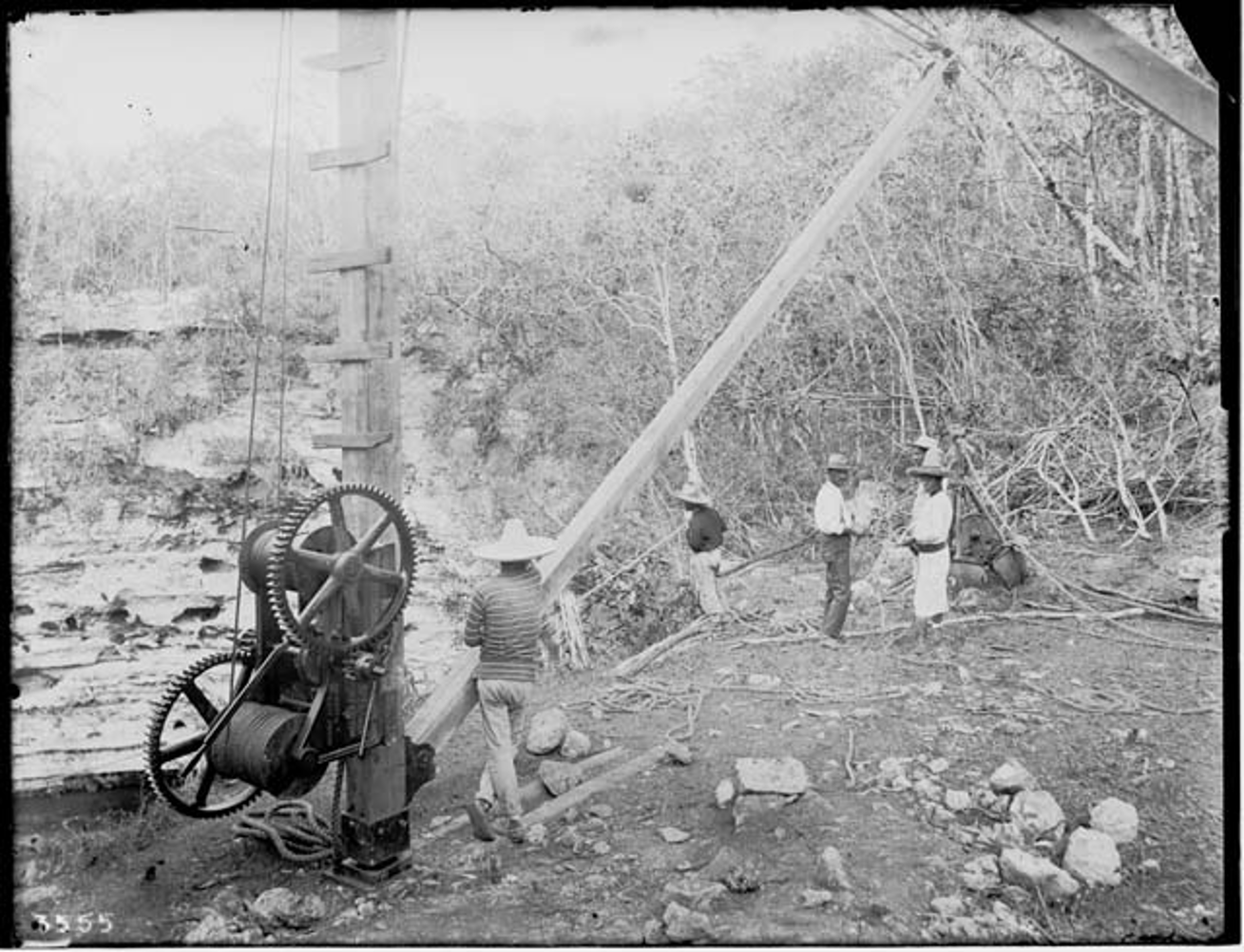
Thompson spent years trying to find a way to drain the Cenote, to get access to the bottom where mud, tree branches, and other “debris” were tangled with the offerings. When he pulled up “muck” that contained copal incense, he was encouraged to continue trying.
He designed various mechanisms (namely the "orange peel” method) but ultimately hired divers and learned to scuba dive, which proved the most successful approach for retrieving the materials without damaging them.
The copal was only the beginning. Thompson’s men washed the offerings by hand, and Thompson claims to have checked every batch of mud to ensure they were not missing anything. Thompson sent pleas for more funding alongside inventories listing bells, ceramics, bones, stones, effigies, gold, masks, jewelry, and much more.
Tracing the Controversy: A Timeline
This timeline was compiled by Peabody Museum staff and Rebecca Mendoza based on available documentation. While it is not exhaustive, it can help us trace the collection as it was created and contested in Mexico and the U.S.

1894
Edward H. Thompson, an archaeologist and U.S. Consul stationed in Yucatán, Mexico, purchases a plantation that includes the Maya site of Chichén Itzá.
1897
Mexico passes the Federal Ordinance on Archaeological Cultural Property, prohibiting the unauthorized export, research, and restoration of archaeological patrimony. This law was one of the earliest of the kind, an attempt to protect cultural heritage from American and European extraction.
1899
Thompson corresponds with Alfred Tozzer, soon to be a faculty member at Harvard, regarding his plans to dredge the Cenote for cultural material and conduct archaeological investigations on the land.
1901
Thompson, while director of a Peabody Museum expedition to Mexico, sends fragments of mural paintings from Yucatán to the Peabody Museum, despite acknowledging in a letter to the museum the 1897 law that outlawed the removal of antiquities from Mexico: “I sent last week by a friend a packet containing portions of mural paintings, originals. I took quite a risk sending them as it is very much against the law as you know, but I am glad to say that they ran the gauntlet safely and I hope that by this time they have reached you...” (Merida, September 1st, 1901; 2019.1.17.4.7.1) In other words, he was aware of the illegality of his practice.
1904-1910
Thompson dredges the Sacred Cenote from 1904-1910
Thompson’s work took place prior to the Mexican Revolution, a period of unrest. Hence, his project was not a priority of the Mexican government although he was exporting objects of archaeological patrimony, which was blatantly illegal according to the 1897 antiquities law. Thompson convinced friends and colleagues—his team of "mules"—to carry precious items hidden in their clothing and luggage as they passed through customs, among other forms of smuggling. These confessions of contraband can be found in Tozzer's diary entries and letters (See Palacios 2017: 672-679). In 1907 the Peabody Museum accessions several hundred items from the Sacred Cenote as part of its collections (Accession 07-7). In 1909 Charles Pickering Bowditch, American financier, archaeologist, and epigrapher, agrees to privately fund Thompson’s work in Chichén Itzá. In 1910 Bowditch gifts cenote collections to the Peabody Museum.
1920s
After the Mexican Revolution (1910-1920), the Mexican government began to work towards recovering materials that had been exported. In 1921 Thompson’s residence burns. In 1926, the Mexican government seizes Thompson’s residence and charges him with the theft and illegal exportation of archaeological patrimony; the Peabody Museum is named as an accomplice.
1935
Thompson dies, and the criminal case against him is withdrawn.
1940s
It did not take long for the dropped court case to hit national news, once again calling for a return of the materials. In January of 1940 Mexican newspaper Excelsior published an article titled “México Reclamará Diez Millones por Joyas Mayas Robadas en 1911” (Mexico will Reclaim Ten Million for Maya Treasures Stolen in 1911). In 1940 Alfonso Caso, director of Mexico’s Instituto Nacional de Antropología e Historia, meets with Alfred Tozzer to discuss the return of a representative sample of the Cenote material. But Harvard and the Peabody were intent on studying and publishing the materials before considering any returns from the collection. On January 10, 1941 Alfred Tozzer wrote in a letter to a colleague: “The Mexican government has asked us to give them a complete inventory of the Chichen Cenote. I fear there is no way out of it.” Regarding the gold, he requested an estimate of the various “specimens” and instructed, “I want to make it as low as will cover the truth.” He concludes his letter stating, “I am completely disgusted with this request as you can imagine,” referring to the Mexican inquiry (47-52-00). Returning to these archives with a critical lens allows us a glimpse into the intentions of Tozzer and his unwillingness to collaborate with the Mexican government. In 1942 the Mexican government brought a civil suit against heirs to Thompson’s estate. In 1944 the Mexican Supreme Court decided that the Harvard Peabody Museum was the rightful owner of the objects. Although the materials were in fact illegally exported, the museum was not directly funding the project and therefore not at fault. It was Charles Pickering Bowditch (1842-1921) who had privately funded Thompson’s work, though he had specified in their agreement that the materials would be sent to Harvard. An internal Peabody memorandum from the late 1940s acknowledged that the court’s decision still “leaves [the Peabody] as the ultimate recipient of objects exported illegally” (Burke).
1950s
Over a decade later, a 1957 letter from the director of the Instituto Nacional de Antropología e Historia in Mexico inquired once again regarding the willingness of the Peabody to return materials for the National Museum. The archives contain troubling letters among Peabody directors during these decades in which they reveal their biases against Mexicans and their desire to maintain control over the collection. Ultimately, the Peabody returned some of the items back to Mexico: approximately 50 gold pieces in 1959 and a selection of jades in 1976.
2026
Today, more than 100 years later, over 3,000 offerings from the Sacred Cenote remain at the Peabody Museum.

3,000+
offerings from the Sacred Cenote still remain at the Peabody Museum.
Part III: Sacred Materials to Museum Storage
A century is a long time for these materials to be far from their homes. The ceremony that began when they were originally harvested, molded, and offered into the Cenote has been interrupted. Today they remain displaced, isolated from their lands, from their gods, and from one another by plastic bags, categorized by type, with catalogue numbers scrawled on their skin. Typical of museum practices of the time, some cultural items may have been treated with arsenic for preservation and pest control. The cultural items from the Cenote—the gold, fabric, copal, stones, bones, and wood—are located in secure museum storage, kept away from light with their humidity monitored by museum staff.

As one of the earliest anthropology museums and encyclopedic in nature, certain collecting practices in the history of the Peabody are emblematic of colonial practices of extraction. Yet, due to calls for decolonization and mounting public pressure to repatriate Indigenous belongings, and especially ancestors, the collections once considered beacons of success and prestige of 19th and early 20th century Western academic institutions such as Harvard have become the ethical and administrative challenges for museums today.
Why we use the term "ancestor"
Research on collections housed in museums is yet another form of extracting knowledge from these materials, similar to old-fashioned ethnography. Still today some scholars continue to justify problematic methods based on their visions of science and progress. However, Indigenous communities have fought to reclaim these materials and to be the ones who ultimately decide if and when research is necessary or desired by and for the community. Indigenous communities are not monolithic and hence, tribes and nations have diverse approaches emerging from unique religious and scientific orientations. This is a type of sovereignty, or self-determination, that is rooted in generations of relationships and traditions of storytelling and caretaking that the museum is unable to do.
Yes, a century is a long time for these materials to be far from their homes... but their story does not need to end here.
Then, what happens next? What would it look like for these materials to continue their journey? To be reunited with human and more-than-human communities? Will Maya peoples have access to these precious offerings or a say over the process of repatriation?
Part IV: Imagining the Past and Ancestral Futures
During her 2019-2020 fellowship at the Harvard Radcliffe Institute, artist Gala Porras-Kim offered a creative provocation based on this same collection.
Precipitation for an Arid Landscape and the Sacred Cenote collections cared for by Harvard’s Peabody Museum
Porras-Kim invites us to think about how offerings stolen from the cenote could “return to their original function” and therefore to their relationship with the Maya rain deity Chahk. She asks the museum to think about the spiritual life of these materials and provides an example with a copal incense sculpture which is regularly “fed” with rainwater while it is in the exhibit.
Porras-Kim's art also reflects the way in which these offerings are both objectified (in the black and white drawings of fragments of fabric) and how they are also vibrant, powerful materials (in the colorful, bright hued entities on display shelves).
"The Sacred Out of Context," Harvard Radcliffe Institute (2022)
"The Peabody directly benefitted from collecting practices that we recognize today ignored the wishes and values of the community... we are committed to ongoing collaboration with descendant communities..."
Porras-Kim's art also reflects the way in which these offerings are both objectified (in the black and white drawings of fragments of fabric) and how they are also vibrant, powerful materials (in the colorful, bright hued entities on display shelves).


Speaking from Experience
From my own experiences at the Peabody (which began in 2021 with encountering this collection once the Harvard buildings reopened after Covid) and through my research on Maya cosmovision and critical Indigenous studies, healing would mean that descendant populations determine exactly what happens next. This starts with the institution ensuring Indigenous access, consultation, and decision-making about their ancestors, ancestral belongings, research, and data.
But this pathway is fraught. Even with legal protections and guarantees, international repatriation is typically a nation-to-nation return in which the ownership of the materials would be transferred to the Mexican government, and their Instituto Nacional de Antropología e Historia. While this is an important step and perhaps the best option, Indigenous communities around the world are often excluded or decentered in that process. Instead of reuniting the materials with their pueblos originarios, they would likely end up in another museum context, either in Mexico City or in the site museum at Chichén Itzá. Nevertheless, Harvard's Peabody Museum cannot be the one to dictate what is right and wrong. Rather, it is the responsibility of the museum to relinquish the control and to ensure that the violence of displacement does not continue. It is for the descendants and community to determine what restitution and repatriation means for them.
There have been changes at the museum in recent years, most significantly in the return of materials to Native Nations and tribes in the U.S. For example in 2022, the Peabody Museum repatriated a sacred totem pole that had been taken from its homeland in the Gitxaała Nation in British Columbia. This can serve as a blueprint for future possibilIties.
Toward Better Relationships
We must also learn from examples from beyond Harvard, as repatriation continues to take place across the country and the world. Below we see how various Indigenous communities have pursued repatriation and healing.
Click the links to listen and learn from those who are directly affected and what it means for ancestors and belongings to come home.
In 2014, Sven D. Haakanson, a member of the Alutiiq Tribe of Old Harbor and professor of Anthropology, used archaeological models of angyaaq (large open boats for transportation, hunting, warring, fishing, etc.) in order to reconstruct a technology which had "disappeared from living knowledge." Only 13 models still existed in museums, and Haakanson used the one in the Burke collection to reverse engineer the full-size angyaaq (25' long) and then bring that knowledge back to his community.
In 2023 another historic Alutiiq/Sugpiaq kayak was transferred to the Alutiiq Museum by Harvard University. The 14-foot, skin boat is a rare example of a complete ancestral kayak. This vessel has been at the center of a long-term collaboration between the Peabody and Alutiiq museums and is currently displayed in Kodiak. The transfer allows the Alutiiq community to care for the kayak, a culturally sensitive object made with human hair.
Read more about Angyaaq revival Haakanson on Sapiens Podcast
In the Associated Press video below Phoeurng Sackona, Cambodian Minister of Culture and Fine Arts, reflects on the importance of repatriation. This footage allows us to glimpse the way these sacred materials are treated with respect. The monks bring flower petals, garlands, and other offerings to bless the statues before they return home.
Check out "Journeys to Complete the Work," a comic book which illustrates and explains the importance of repatriation written by archaeologists Sonya Atalay (Anishinaabe-Ojibwe), Jenn Shannon, and John D. Swogger.
Dahomey (Mati Diop, 2024) is a film which documents the process of repatriation as 26 objects from the Kingdom of Dahomey leave Paris and are returned to present-day Benin. In the film we hear the voices of the statues narrating the process alongside the reactions of the youth. The film amplifies these powerful perspectives while revealing the complex and ongoing effects of colonialism.
Thank you for following along on this (unfinished) story
Unless otherwise noted, all images Courtesy of the Peabody Museum of Archaeology and Ethnology, Harvard University.
Author
Rebecca J. Mendoza is a Chicana born and raised in Colorado. She is the daughter and granddaughter of Mexican migrant farm workers and northern European settlers. Rebecca is a PhD candidate in the Study of Religion at Harvard with broad interests in Indigenous traditions of the Americas, decolonial theory, anthropology, museum ethics, and Latinx and diasporic ceremonial life. More specifically, Rebecca explores how Mesoamerican materials act as conduits of power, knowledge, and relationality from precolonial to contemporary times.
Rebecca graduated from Harvard Divinity School (MDiv) and the University of Oregon (BA) and she has professional experience in community organizing, advocacy, education, and storytelling. She was a 2022 Summer Pre-Columbian Fellow at Dumbarton Oaks, a Graduate Student Associate at the David Rockefeller Center for Latin American Studies, and in 2023 she was awarded the Ford Pre-Doctoral Fellowship. She has worked at the Harvard Peabody Museum as a collections assistant and conducted research on Special Collections at Tozzer Library as a Pforzheimer Fellow in 2025 and 2026.

Acknowledgments
Thank you to Jennifer Carballo (Mesoamerican Lab) for inspiring me to continue to pursue this research since I first met copalli in the Peabody Museum in your archaeology course and for overseeing my work in making this story accessible to others. Thank you to Peabody staff, especially to Meredith Vasta for your incredible mentorship and Emily Rose for being a kind point of access to the collection. Over the years this research has been expertly guided and generously supported by Professors Bill Fash and Davíd Carrasco and the Moses Mesoamerican Archive and Research Project (MMARP). Finally, and most importantly I dedicate this work to Maya people past, present, and future.
References & Sources for Further Research
Arnold, Philip P. "Rain Deities." In The Oxford Encyclopedia of Mesoamerican Cultures. Ed. Davíd Carrasco: Oxford University Press, 2001.
Barquera, Rodrigo, and colleagues. “Ancient Genomes Reveal Insights into Ritual Life at Chichén Itzá.” Nature, June 12, 2024, 1–8.
Browman, David L., and Stephen Williams. Anthropology at Harvard: A Biographical History, 1790-1940. Peabody Museum Monographs ; No. 11. Peabody Museum Press, Harvard University, 2013.
Burke, Spencer. “Envoy: From Deep to Dark,” The Harvard Advocate, accessed May 2023.
Cobos, Rafael. "Chichén Itzá." In The Oxford Encyclopedia of Mesoamerican Cultures. Ed. Davíd Carrasco: Oxford University Press, 2001.
Coggins, Clemency, and Orrin C Shane, eds. Cenote of Sacrifice: Maya Treasures from the Sacred Well at Chichén Itzá Austin: University of Texas Press, 1984.
Coggins, Clemency. Artifacts from the Cenote of Sacrifice, Chichen Itza, Yucatan: Textiles, Basketry, Stone, Bone, Shell, Ceramics, Wood, Copal, Rubber, Other Organic Materials, and Mammalian Remains. Peabody Museum of Archaeology & Ethnology, Harvard University: Distributed by Harvard University Press, 1992.
Doyle, James. "Into the Centipede's Jaws: Sumptuous Offerings from the Sacred Cenote at Chichén Itzá." Perspectives, The Met. May 21, 2018.
Doyle, James, and Stephen D Houston. “The Universe in a Maya Plate.” Maya Decipherment, March 4, 2017.
Mendoza, Rebecca J. “Ritual Relationships with Copal Incense: Reinterpreting 21st Century U.S. Contexts through Indigenous Mesoamerican Ontologies.” Indigenous Religious Traditions 1, no. 1 (2023): 4–24; “Beyond The Gates.” CONTINGENT, November 23, 2023; “Undisciplining the Museum: Indigenous Relationality as Religion.” Religions 15, no. 11 (2024): 11; and (forthcoming) “A Debt to Decay?” Numen vol. 73 (2026).
Palacios, Guillermo. “El dragado del cenote sagrado de Chichen Itzá 1904-c.1914.” Artículos. Historia Mexicana (Mexico City, Mexico) 67, no. 2 (2017): 559–740.
Peabody Museum Collections Online. “Collections – eMuseum.”
Pérez de Heredia Puente, Eduardo J. Chen K’u: The Ceramic of the Sacred Cenote at Chichén Itzá. 1998.
Soto Laveaga, Gabriela. “The Pole Is Back Home.” In Empire, Colonialism, and the Human Sciences: Troubling Encounters in the Americas and Pacific, edited by Adam Warren, Julia E. Rodriguez, and Stephen T. Casper, 307–10. Cambridge: Cambridge University Press, 2024.