


Washington and his sash through time
On view May 25–October 18, 2026
Presented within All the World Is Here to mark the 250th Anniversary of the United States Declaration of Independence.
This blue sash has taken a journey to the Peabody Museum, touching history along its way. It appears in this 1776 painting by American artist Charles Willson Peale. George Washington—thirteen years away from being elected president of the United States—wears regalia befitting his status as the newly appointed commander-in-chief of the Continental Army.

Silk taffeta sash, formerly worn by George Washington
979-13-10/58761
Gift of the heirs of David Kimball
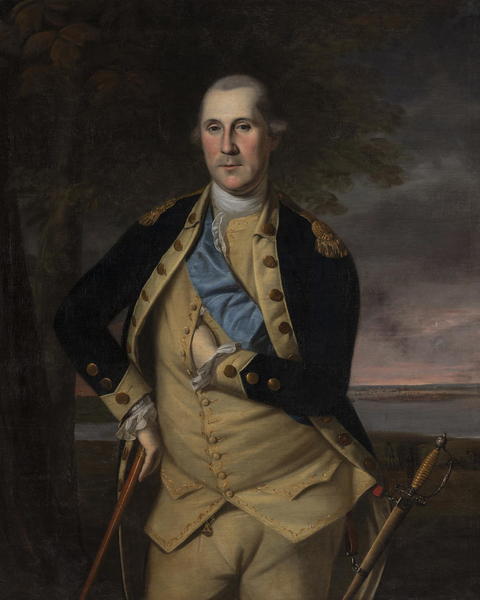
Charles Willson Peale (American, 1741-1827). George Washington, 1776. Oil on canvas, 44 x 38 5/16 in. (111.7 x 97.3 cm). Brooklyn Museum, Dick S. Ramsay Fund, 34.1178
The sash appears again in Peale’s 1779 painting of Washington at Princeton that was commissioned to commemorate the victories of Trenton and Princeton. In this painting, Washington, again bedecked in sash, coat, and waistcoat, leans on a cannon with Princeton College and prisoners of war in the background.
The same blue sash appears in other depictions of Washington through 1779, including Peale’s 1776 miniature of Washington and a 1779 etching by Swiss artist Pierre Eugene du Simitere. By 1780, Washington is no longer depicted wearing the sash in any subsequent paintings.

Charles Willson Peale (1741–1827; born Chester, MD; died Philadelphia, PA), George Washington after the Battle of Princeton, 1779–82. Oil on canvas; 244.2 × 156 cm, 105 × 71 1/16 × 2 3/4 in (frame). Princeton University, bequest of Charles A. Munn, Class of 1881 (PP218)
Following the sash
So, what does the provenance trail tell us about the journey of the sash from George Washington to its current location at the Peabody Museum? To follow this journey, we start with the last known owner of the sash, Moses Kimball.
Museum documentation suggests that the item was likely donated by the heirs of David Kimball after having been part of the Boston Museum collection. The documentation also indicates that, at that time, a label affixed to the sash stated, “Washington’s Sash. Presented by Himself.” From 1926-1979, the sash was on long-term loan to the Old South Church. The sash was returned to the Peabody in 1979, however, that original label was lost.
Kimball's Boston Museum
The sash’s last known location was at the Boston Museum. Part museum, part theater, part wax museum, and part zoo, the Boston Museum was founded by Moses Kimball in 1841. When the Boston Museum closed in 1899, nearly 1,400 items from the Boston Museum came to the Peabody Museum through the heirs of David Kimball, nephew of Moses Kimball.
An 1850 advertisement described the Boston Museum's key attractions, stating that:
"The museum is the largest, most valuable, and best arranged in the United States. It comprises no less than seven different museums, to which has been added the present year, besides the constant daily accumulation of articles, one half of the celebrated Peale's Philadelphia Museum, swelling the already immense collection to upwards of half a million articles, the greatest amount of objects of interest to be found together at any one place in America; and an entirely new hall of wax statuary.... and the immense collection of birds, beasts, fish, insects and reptiles;...paintings, engravings and statuary; ... the duck-billed platypus;...the curious half-fish, half-human Fejee Mermaid;..."
This description indicates that Kimball acquired half of the collection from Charles Willson Peale’s Philadelphia Museum when it closed. The sash was one of those items.

The first Boston Museum building (ca. 1841-1846) located at 18 Tremont Street, Boston (Wikimedia)
Peale's Philadelphia Museum
Working backward, Charles Willson Peale was the previous owner of the sash. Peale—the same artist of the Washington portraits--first opened the Philadelphia Museum in 1784 as an art museum. By 1786, the collection grew to include natural history, Native American items, and other historical collections. When Peale passed in 1827, his son Titian took over running the museum until it closed in 1843. In 1848, much of the collection was put up for auction and an 1848 sales catalog noted that the collection included “Washington’s Sash & various curiosities.” The Philadelphia Museum collection was largely split between two men: P. T. Barnum and Moses Kimball, founder of the Boston Museum.
The now-lost label that was pinned to the sash identified it as: “Washington’s Sash. Presented by Himself” suggests the long and personal relationship between Peale, artist and museum founder, and George Washington. Peale painted Washington several times in his life and in a letter to Edmond Jennings in 1775, Peale stated, “I am well acquainted with Gen l W. who is a man of very few words but when he speaks it is on purpose [and] what I have often admired in him is he [has] always avoided saying anything of the actions in which he has engaged in the last war. [H]e is uncommonly modest, very industrious – prudent.” It is tempting to consider that the gifting of the sash was one of friendship, although that is pure speculation. What we do know is that the sash came to Peale from Washington himself and was so important to Peale that he displayed in his museum.

Charles Willson Peale, The Artist in His Museum, 1822, oil on canvas, 263.5 x 202.9 cm (Pennsylvania Academy of Fine Arts).
The journey of the sash from Washington to Peale, Peale to Kimball, and from Kimball to the Peabody Museum (with a 50-year stop at the Old South Church in Boston) also suggests the importance of this historical item associated with George Washington himself. Washington’s sash is cared for by the Peabody as a highlight in the collections and through the careful curation of previous owners, it is now celebrated 250 years after the Revolutionary War as a commemoration of Washington in his role as commander-in-chief of the Continental Army.
The sash is on display on the 4th floor of the Peabody Museum from May 21 - September 20, 2026. From May 21, 2026 - April 20, 2027, artifacts related to the American Revolution excavated from Harvard Yard and Fort Independence are on display in the first floor Peabody Museum lobby cases.

Silk taffeta sash, formerly worn by George Washington
979-13-10/58761
Gift of the heirs of David Kimball
Further reading
For more information on George Washington’s sash and Peale’s Philadelphia Museum, please see Charles Coleman Seller's 1980 book, Mr. Peale’s Museum: Charles Willson Peale and the first popular museum of natural science and art (Norton).
Philip C. Mead provides further detail on the sash in his article, “George Washington’s Disappearing Sash” in Commonplace 15.2 (Winter, 2015).
The sash is also discussed in the forthcoming 2026 book, George Washington, Slavery, and the New Politics of Style, 1743-1789 by Horace Ballard (Bloomsbury Academic).
To view more images of portraits of George Washington through time, please see Life Portraits of George Washington.